O, to be in England (at last), now that April's May is there....
As mentioned in a previous post, a much-planned-for trip to England was eagerly anticipated, and I am happy to announce that it finally came to pass, albeit a few years later than we wanted and a month after that evoked in Browning's famous verse. Leaving aside irrelevant stories both humorous and horrific about our trip, I will focus here on sharing a few highlights that relate to, well, my relations.
Edward I (1239 - 1307), a 21x great-grandfather, looms largest, long shanks and all, but other royals, aristocrats, and commoners like myself, appear as well. As so it should be.
One of my pre-trip preparations, beyond a wall-size map with pushpins, photos, and strings--not unlike those seen in movies about obsessed detectives--was creating sheets showing where ancestors of mine had lived in England. I used two filters: one, that each was the earliest immigrant ancestor, the first to go from there to here; and two, that their information was verifiable. I ended up with about thirty candidates, knowing we could not see them all, at least this time. I next plotted out which of their locales matched destinations we planned on visiting. Happily, three of our "tentpoles," London, the Cotswolds, and Manchester all had historic kin suitably close by.
Pictured below is an example of one of the pages I made, this one for 10x great-grandfather Thomas Norton (1609 - 1648) and his wife Grace Wells (1611 - 1648), who arrived with their daughter Grace Norton (1634 - 1704) sometime before 1639, and settled in Guilford, Connecticut.
 |
One of my pre-trip planning sheets.
Each had the who, when, and most importantly, where!
|
Well, more than settled: Norton was one of Guilfords' founders. The website Visit Guilford says this:
On June 1, 1639, more than a month before Guilford's founders reached the New England shore, 25 Puritan men bound their lives to each other in a Covenant, setting forth their vision for the community they would create together. Aboard the English ship St. John, these men signed their names to a document that stated their intentions to settle with their families as a group near the plantation of Quinnipiack (later New Haven), and to help each other survive and prosper in the New World.
Thomas Norton was one of the signers of the Covenant, along with another ancestor, 11x gg Francis Bushnell (1580 - 1646). Norton's grandson Caleb Seward (1662 - 1778), about whom I have written before, married Bushnell's grand-daughter Lydia Bushnell (1661 - 1753); they are paternal 9x great-grandparents.
 |
The Guilford Covenant.
The original is one of the few documents of its kind in the collection of the
Massachusetts Historical Society.
Photo courtesy the Guilford Free Library Archives |
However interesting, it turns out that that Thomas Norton would not be someone whose English birthplace or home we would visit whilst in England. But his grandfather, also named Thomas, was definitely--and inadvertently--on our itinerary.
Catching up with an episode of the genealogy show Who Do You Think You Are that first aired in late 2018, we learned about some of the ancestry of actor Josh Duhamel (although I suppose if he were more famous I would not need to explain who he is). My ears pricked up when they mentioned that Guilford's Thomas Norton was one of his ancestors as well.
 |
Cousin Josh.
(Photo courtesy of The Learning Channel) |
The show skipped quickly over immigrant Thomas Norton's father, Robert Norton (abt 1575 - 1635), which is a shame. He was an an engineer and author, who wrote such books as The Gvnner: Shewing the Whole Practice of Artillerie: With All the Appurtenances thereunto Belonging, among others. He was also a poet. He wrote one of the introductory "panegyricks" for his friend John Smith (yes, the Pocahontas one!) to use in Smith's General Historie of Virginia, New-England, and the Summer Isles. Smith returned the favor, and wrote a verse with the unctuous title "In the Due Honor of the Author Master Robert Norton." You can read it here.
Yet we still have not reached England, or Robert Norton's father, the Thomas Norton whose haunts we would visit. The portentous narrator of Who Do You Think You Are had a lot to say about him.
Although born to a London grocer (also named Thomas!), Thomas Norton (1532 - 1584) definitely made good. He went to Cambridge, studied law at the Inner Temple, got involved in politics, and even had the ear of Queen Elizabeth I. WDYTYA covered all those bases, albeit quickly.
One tidbit that particularly excited me was that Norton co-authored a play (with Thomas Sackville) that was performed for Queen Elizabeth in January 1561. The play was called The Tragedie of Gorboduc, later revised by the authors and retitled The Tragedie of Ferrex and Porrex. I had to track down a copy, of course, which I purchased second hand. I found it included in a hefty volume called Elizabethan and Stuart Plays, edited by the imposingly named combo of Charles Read Baskervill [sic], Virgil B Heltzel, and Arthur H Nethercot.

Gorboduc is not much of a read these days (although according to elizabethandrama.org, it features the first appearances of the word "motherland" and phrase "gaping wound"), and the last record I could find of a full performance was this:
Students at the Hull Municipal Training College [Kingston upon Hull, Yorkshire, England] perform the play (13 December 1928),
with an almost all female cast, under the direction of Dr A.E. Parsons. Repeat
performance on Wednesday, 27 February 1929.
But despite that, it is important for two reasons: it is the first English history play, and the first to use iambic pentameter blank verse. And this almost thirty years before Shakespeare's first plays! The Bard borrowed heavily from Gorboduc for the plot of his King Lear as well; both plots revolve around kings who divide their kingdoms between their offspring, with tragedy following close behind.
Still intrigued by Thomas Norton, I got another book--this time from the library--The Tudor Parliaments: Crown, Lords, and Common, 1485 - 1603 by Michael A R Graves. A scholarly text from 1985, I have to admit I only read the sections on Grandpa Norton. There was this:
Foremost among them was Thomas Norton. He was a lawyer, the lord mayor's first 'remembrancer'...."
As a formidable debater, an inexhaustible committee man, a prolific parliamentary draftsman, and a popular Common's man, he was the lord treasurer's ideal instrument to further his ends.... (p 149)
Interesting. But also this:
He was a moderate puritan, but it was his obsessive hatred of popery which made him a political activist.... (ibid)
Or, as Wikipedia puts it more vividly:
Norton's Calvinism grew, and towards the end of his career he became a fanatic. Norton held several interrogation sessions in the Tower of London using torture instruments such as the rack. His punishment of the Catholics, as their official censor from 1581 onwards, led to his being nicknamed "Rackmaster-General"....
We arrived at Heathrow International Airport midday in late May. We picked up our rental car and made our way to our lodgings in London, stopping briefly at IKEA on the way (one of the only stops my other half requested, despite the entirety of the UK available as options). It was fun; they had photo ops with a cutout of Queen Elizabeth throughout the store in honor of her Jubilee.
 |
| L: His only contribution to the planning map. R: a sign within IKEA. |
Our first full day in London began early at the Sky Garden, giving us extraordinary views of many of the city's landmarks. Aptly, the first site we spotted was The Tower, where Grandpa "Rackmaster" Norton executed--so to speak--his craft over four hundred years ago.
 |
| Our first view of the Tower, from the Sky Garden. |
Perhaps the less said about that part of the Tower, the better. It balanced the scales somewhat to learn that Norton himself was briefly imprisoned there himself, Elizabeth's council forced into it by English bishops. He stayed just a few days and was released due to ill health, returning to his native Bedfordshire and dying soon after.
A more salutary ancestor, Edward I, also spent time at the Tower. I'm pleased to mention that while there he was neither torturing nor imprisoned. In fact, like his father, Henry III (1216 - 1272) before him, he expanded the site, adding what is known now as the Medieval Palace, including St Thomas's Tower, which was used as the royal apartment. There was a fantastic display there recreating Edward's bedchamber, along with many artifacts. I felt an incredible frisson being there, connecting with an ancestor from so long ago. Almost seven hundred years!
 |
L: Edward's bedchamber, suggesting that how I make my bed is genetic.
R: thick walls and long shadows. |
It was lovely and strangely reassuring, the permanence and tradition, compared with so much of American culture, which, even putting aside our relative youth as a country, seems only to value the new; anything over even a mere hundred years old is vanished, obsolete, or looked on either with pity or, less often, awe as a relic, behind ropes or with a plaque. Anyway.
Heading up the Thames, we next visited Westminster Abbey, imposing on the outside, overwhelming once inside. The size, the scale, the history! There are countless memorials to many of the grandest name in British history. I especially enjoyed "Poet's Corner," where authors from Browning and Dickens to Auden and Wodehouse are memorialized. Although the site is much older, the current Abbey was begun under the direction of Henry III in 1245.
Along with a myriad of royal marriages and burials, the Abbey has been the home to every English coronation since 1066. I have four of those monarchs in my family tree. I mentioned two already, but here's my royal line:
Henry II (1133 - 1189) + Eleanor of Aquitaine (c 1122 - 1204)
He reigned 1154 - 1189; they married 1152. Their son:
John (1166 -1216) + Isabella of Angoulême (c 1189 -1246)
He reigned from 1199 - 1216; they married 1200. Their son:
Henry III (1207 - 1272) + Eleanor of Provence (c 1223 - 1291)
He reigned 1216 - 1272; they married 1236. Their son:
Edward I (1239 - 1307) + Eleanor of Castile (1241 - 1290)
He reigned (1272 - 1307); they married 1254.
(You may have noticed the ten year gap between the reigns of Henry II and John. That spot was held by Richard I aka Richard the Lionheart (1157 - 1199), Henry II and Eleanor's third son, John's older brother, and so my 23x great-uncle.)
Nifty as it would be to count Edward II as another great-grand, I descend from his sister, Elizabeth of Rhuddlan (1282 - 1316), who married Humphrey de Bohun (1276- 1322) in 1302, at--guess where!--Westminster Abbey. She was the eighth and last of Edward I's daughters, and closest in age to Edward II.
And as an aside, does anyone else feel how mind-boggling these dates are? Perhaps I sense it more strongly since I am thinking about my connection to these people and their time. Anyway.
About those coronations. The chair itself was ordered by Edward I to be built, after he brought back the Stone of Scone (which delightful name sounds like something from a fairy tale) from Scotland in 1296, and was believed first used 1308. The chair has seen a lot of wear and tear, additions and repairs, and even the return of the Stone to Scotland in 1996, although it will be brought back to Westminster for the crowning of King Charles III later this year.
It has lasted through bombings and suffragettes, was hidden during wartime, and even subjected to schoolboy graffiti. Yet it endures. Even behind plexiglass, it was thrilling to see, the more so because some of my family's bums have sat upon its majesty.
It is hard to pick a highpoint from Westminster Abbey. Although we spent several hours there, it was not enough to take in everything. Of my four royals, two are buried there, and we did find their tombs. I especially liked that of Henry III, monumental, as befits the monarch who had so much of the Abbey built. We will definitely go back.
 |
| The tomb of Henry III. |
We would meet up with Edward and his father again at another destination, visiting Winchester, about sixty miles southwest of London, in Hampshire. We skipped that Abbey (I know! Next time...) and went instead to the Great Hall. The Hall is all that remains of Winchester Castle, originally built by William the Conqueror and demolished in 1649 under the orders of Oliver Cromwell. 22x great-grandfather Henry III was born in the castle, and added the Great Hall, an endeavor that took many years, beginning in 1222.
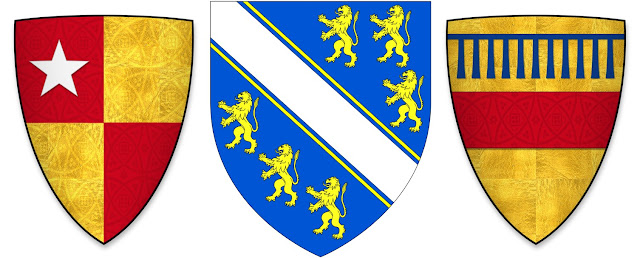
There was a lot to see, and for me, two particularly rich genealogical treats. The first was a bank of beautiful stained glass windows, added in 1874, at the height of the period when all things medieval were coming back in vogue. They showed coats of arms for the Plantagenet kings and many of the nobles of their time, including some of the Magna Carta barons from whom I also descend. The section pictured below features Henry III, and also Saher de Quincy (abt 1155 - 1219), a 24x great-grandfather.
 |
| DeQuincy's crest is in the middle of the right-hand column. |
Also from 1874 was a huge mural, showing the lineages of many of those same families, beginning high up under the eaves with Edward I, and continuing beneath him--in every sense.
There were two other parts of the Hall we especially enjoyed. The first was Queen Eleanor's Garden, an even newer addition, added in 1986, named after two Queen Eleanors: the wives of both Henry and Edward! Perhaps the apostrophe is misplaced? In any case, it was nice to see women represented, and it was a truly beautiful English garden, recreated in the medieval style. We lingered for some time, enjoying the sights and scents.
The crowning glory--no pun intended--and something that had been on my England Bucket List since before folks even said "bucket list" was the Round Table. Whether it was hearing the Camelot LP playing on my folks' turntable, or seeing The Sword in the Stone at the drive-in, the legends of King Arthur and his Knights were profoundly wrapped up in my childhood. One of the first "big" books I read as a child (and have reread almost annually since) was T H White's The Once and Future King. Although purely mythic, seeing the Round Table moved me more than almost anything else on this trip.
What I had not known all those years was that the iconic table I had seen photos and drawings of for so long was actually created by Edward I! For reasons most likely personal and political, Edward--like me--was a fan of all things Arthur, and commissioned the table to be displayed at a Round Table themed tournament in about 1290, to celebrate the betrothal of one of his daughters.
For many years the table was purported to actually be from King Arthur's time (whenever that may have been), then later was believed to be a much more modern creation. More recently, carbon-14 dating methods have shown that it is made of English oak, and in fact dates from Edward's time. It was built as an actual table, but has hung on the wall, legs removed, since the mid-1500s. It was Henry VIII who had it painted as we now see it, complete with Tudor Rose.
 |
| Don't let it be forgot.... |
The next stop on our Arthurian quest was Glastonbury, the ancient town steeped in all types of mythic lore and legend. Just the other day while channel-hopping--television, that is, not English--I came across an interesting episode of some program (Ancient Aliens, perhaps?) revealing the "truth" about the Glastonbury Zodiac. Look for it when you're not feeling too skeptical.
Back to the Matter at hand, Glastonbury Tor is believed to have been Arthur's Avalon, or at least the inspiration for it. Indeed, in photos of the Tor in fog, rising high above the Somerset plains, it does resemble an island. Beyond the Tor, there is another connection to King Arthur in Glastonbury. And once again, it involves Edward I.
Glastonbury Abbey's origins are unknown, but it may have begun as a monastery in the 8th century, perhaps on the site of an even earlier Roman or pagan place of worship. Of course. Wealthy and prosperous, it was so well-established by the mid-12th century that a history of the Abbey was commissioned, liberally sprinkled with enough unsubstantiated claims as to read like a travel brochure. And indeed, the Abbey became a place to which the devout--or merely curious--made pilgrimages. Until 1184, that is. That year, a tremendous fire destroyed much of the property, and although a new building, the Lady Chapel, was erected and consecrated within a couple of years, the Abbey was still not getting the tourists (and the money that came into Glastonbury with them) that they once were.
Then in 1191, there was an amazing "discovery": the tombs of King Arthur and Guinevere. And I use quotes around discovery because to this day scholars argue whether the Glastonbury clergymen actually believed their claim or if it was just a publicity stunt. A body, or two bodies were found, either under an oak or where a new grave was being dug. Accounts vary; one even claimed there was an iron plaque above the site which read "Hic jacet sepultus inclitus rex Arturius in insula Avalonia": Here lies buried the famous King Arthur in the island of Avalon.
Either way, the pilgrims and other tourists returned, bringing in much-needed revenue for the restoration and expansion of the Abbey. Almost one hundred years later, aware of Edward's love of all things Arthur, and no doubt valuing the royal imprimatur such a visit would bring, the presiding Abbot invited the king and queen to a splendid ceremony at the Abbey to see Arthur and Guinevere reinterred in a new location.
You've got to give those monks credit. All these years later, in this Newer Age, Glastonbury is still a quirky, mystical tourist town. True or not, there was still something ineffable and magical in the ruins of the Abbey and sight of the Tor. I'm going to believe in it all.
Heading north, we next went exploring in the Cotswolds. Not only ridiculously scenic, this idyllic Area of National Beauty was also once home to another of my ancestors.
James Whiton (1624 - 1710), an 11x great-grandfather came to the not-yet United States by 1647, when the first records show him in Hingham, Massachusetts. Later that year he married Mary Beal (1623 - 1696).
Hingham was settled by the British in 1633, and was first known as Bare Cove. Within two years, the town was officially founded, given the name Hingham, due to the fact that many of the earliest inhabitants were from the English town of Hingham, Norfolk. Beal and Hobart were common surnames early on (both appear in Whiton's wife Mary's lineage), along with Lincoln. Yes, Abraham Lincoln's first American ancestor, Samuel Lincoln (1622 - 1690) was another Hingham, Norfolk transplant. In the next generation, one of James and Mary Whiton's sons, Enoch, married a Lincoln.
Anyway. What of James Whiton? Almost nothing is known about Whiton's life prior to coming to the Massachusetts Bay Colony. But once there, he is well documented. A yeoman and freeman, he and Mary had nine children, although just five lived to adulthood. In 1676, Whiton's home--along with several others--was burned down by members of the indigenous Wampanoag, who were perhaps upset that they were not paid for the land Hingham was on until almost thirty years after it was "founded." Even despite the fire, by the time of his death Whiton was a wealthy man, one of the largest tax-payers in Hingham, due primarily to land ownership throughout the region.
He is considered the first of the surname Whiton (and its more common variant, Whiting) to have come to this country. And to this day the name lives on in Hingham: there is a Whiton Avenue, and one of the meeting rooms in the Hingham Library is named for the family.
James Whiton, though, was not from Hingham, Norfolk however, but instead the village of Hook Norton, in Oxfordshire. (Despite the coincidental name, there is no connection between Thomas Norton or his family and Hook Norton, or its larger neighbor, Chipping Norton.)
We have a fella named Walter Faxon to thank for uncovering this piece of James' past, in a submission to The New England Historical and Genealogical Register entitled "Whiton, Hobart, Turner, Beal, and Jacob." The journal began publishing in 1847, but I have not been able to pinpoint when Faxon shared his research. It was before 1984, at least; I found the reference in an anthology from that year.
 |
The John Beale and Nazareth Turner seen a few lines below
James Witon [sic] are James' wife Mary's parents. |
The relevant passage:
Hook Norton, Oxfordshire ---
James Witon [sic] the sonne of Thomas Witon was baptized the xxth day of March 1624.
Indeed. James was baptized at St Peter's Church, on March 22, 1624. According to its website, the church dates back at least to 922 AD, when it appeared in the Anglo-Saxon Chronicle. Much of the current edifice dates from the 15th and 16th centuries, though a 12th century chancel is still extant. Older than all of that, however, is the baptismal font, which dates from the Norman era. It is where Grandpa James was baptized almost four hundred years ago, and I came to see it.
We were staying just a few miles from Hook Norton, and started our day by having breakfast at the Hook Norton Brewery, a rare, still family-owned brewery, its wonderful Victorian era building still in use, and still using shire horses to make some deliveries. The village of "Hooky," as it is known, is a delight; the houses not numbered, but named such quaint addresses as Anvil House, Farthings, and Goslings Cottage. We enjoyed walking through it tremendously on our way to St Peter's.
 |
| St Peter's Church, as seen from the graveyard. |
Reaching the church, I looked around the graveyard first, wondering if I might find tombs of ancient Whitons. Alas, most of the stones were too weathered to make out. I circled the church, taking it in from all angles, until I realized I was forestalling what I thought might be an emotional moment. It was.
The interior of the church was obviously ancient, but also clearly still in use by the parish. Modern plastic furniture and toddler toys clustered under a wall of centuries old stain glass. It was wonderful to see that the church remains a vital part of village life. And there, off to one site was the baptismal font. I looked at for a long while, circling it, and even reached out to touch its limestone carvings, although I can't say why.
Even apart from my family connection, it is a curious thing, marking a particular moment in time. One side is adorned with crude figures of Adam and Eve (with pigtails!), their names carved on their torsos, apparently in case one could not identify them, while on the other are figures from the zodiac, among them a centaur representing Sagittarius and a figure presumed to be Aquarius. Christianity had taken hold, but the old ways still had to be honored. Then and now.
 |
Two aspects of the font. Decency forbids sharing
Adam & Eve in all their naked shame. |
I was there, in the same spot as someone from my family had been, hundreds of years apart in time. But the kinship and sense of belonging there was absolute. Then and now. It's one of the reasons I love genealogy. The feeling caught me off guard, and is still hard to describe.
Although we don't know why James Whiton left Hook Norton--not for the religious persecution that drove all those from Norfolk to the New World--it was time for us to move on, because we had more to see.
After another day in idyllic Oxfordshire, we headed north, making Manchester our next base for sightseeing and--of course!--more family history. In this case, however, the family connection is a little less clear. I know that Thomas Davenport (1617 - 9 Nov 1685) is one of my 10x great-grandfathers, and was my immigrant Davenport. There were in fact, three Thomas Davenports who all came to the nascent United States about the same time, all with wives named Mary, so what facts there are are hard to sort and verify. To keep things clear, they have been identified ever since by where the lived upon arrival, so my Grandpa Thomas is known in genealogical circles as "Thomas of Dorchester [Massachusetts]."
The Davenports are a fascinating line. I've written about them often, in particular in posts about my 8x gg, a furniture maker also named Thomas Davenport (10 Dec 1681 - 16 Aug 1745), here, and my 4x gg, Stephen Addison Davenport (20 Nov 1806 - Dec 1850), who died trying to make his fortune during the California Gold Rush, here.
What I have not written about are Thomas of Dorchester's ancestors, because we don't know who they are. He is one of my solid brick walls. We know he was born in England about 1617, but like James Whiton, the only details we have about his life are after he immigrated. We are able to place Whiton in Hook Norton due to a citation of an ancient church record. It took modern science to helps us find Thomas Davenport's ancestors: DNA conclusively tells us that he was descended--somehow!--from Orme de Davenport.
Orme's birth and death dates are in dispute, but it was long enough ago that he was said to be a cousin of William the Conqueror. The Davenports were long a prominent family in northwest England, particularly Cheshire. By 1160 they were in charge of Macclesfield Forest, and acquired more land and power with each generation, finally acquiring our next destination, Bramhall Hall, in 1370, when a John de Davenport married Alice de Bromale.
The Davenport family occupied Bramhall Hall for the next five hundred years (!) until, in 1877, an impoverished Davenport sold it to a Manchester concern. It was purchased a few years later by another family, who ran into their own money problems in the early 1920s. First the furniture was auctioned, then the house was offered, with the possibility it might be torn down if not sold. An offer came, thankfully, and by 1947 a group, The Friends of Bramall Hall, was formed. They began restoring the home and replacing furniture. In 1974 a local government authority finally took over the home, and the house and grounds are now open to the public.
And from the look of things, thoroughly appreciated. I was eager to get there, so we arrived early, and found the park already full of visitors, feeding the waterfowl that swam in the Ladybrook, or strolling the seventy acres of gardens, all that remain of the once much-larger estate. After we'd had another delicious classic English breakfast, the Hall opened.
 |
Too early to enter, I passed the time taking a lot of snapshots
of the beautifully timbered exterior.
|
Once inside, the first person I met was one of the onsite genealogists, who kindly offered to help try to connect Thomas of Dorchester with the rest of the family. I was hopeful, despite the fact that this has been a question descendants have been working on for years. Perhaps she had resources that weren't yet online, or published elsewhere? Alas, despite slogging through endless Thomases in every generation (amongst an awful lot of Williams), she was not able to find anything.But it was the only disappointment of the day. Well, that and not getting to see Oscar the Otter, a taxidermized specimen that was not on display due to apparent refurbishment. I was hoping to get a picture to show our otterhounds, one of whom, coincidentally, is named Oscar.
 |
| Oscar was not present, but I got a photo of the placard at least. |
The Hall was a marvel in its own right, though, easily making up for the misplaced mammal. From the 16th century wall murals (some of the oldest surviving works of their kind in England) to the Withdrawing Room, with its astounding plastered ceiling, there was something to admire everywhere. I took a lot of pictures, and more than once felt that preternatural "my people were here" vibe.  |
Your Humble Blogger, posing in front of a portrait
of the fifth William Davenport. (There were at least eight.)
I like to think there's a family resemblance. |
That feeling, not quite déjà vu, but a comfort and familiarity followed me throughout our English trip, even into places that had no apparent connection to my family. Wandering through book stalls in Portobello Road, or strolling the gravel paths at Eltham Palace felt easy and right, somehow part of my collective memory despite never having been there before.
Nearly a year later, I'm still remembering, still thinking of these diverse things. Despite only visiting one of the ancestors for whom I made a fact sheet (again, those magic words: next time!), I feel I learned a lot about English history, my family, and myself. My lifelong Anglophilia, though: was it learned or purely genetic? Most likely some admixture of the two.
What did I inherit? Ancestral stories, of course. But more, starting with what I've come to call an "amiable eccentricity" that I saw mirrored in so many of the faces of the people we spoke with. A love of sausages, humor, Arthurian legends, gardens, Englishness, and even dogs.
Yes, King John, who gets short shrift in this post--as in history itself--was a dog lover. He is named in the earliest mention we have of otterhounds. John's son, Edward I appointed a Huntsman to lead the royal pack of otterhounds, and the hounds continue through history. Queen Elizabeth I was the first female Master of the pack.
In more recent years, the sport of otter hunting was banned, and along with other factors the once respected otterhound is now a vulnerable breed, risking extinction. We are lucky enough to have three of this ancient breed: the aforementioned Oscar, as well as our Huck and Buttercup. They are absolutely part of our family. When we first got our loveable goofs, I had no idea that they too would become a part of my ancestral story as well. Coincidence or a genetic callback?
So despite his bad rep as "Bad Prince John" (in another set of legends, for another day) I can excuse Grandpa John a lot. If he loved dogs, he can't have been all bad.
 |
L: King John and an unknown dog.
R: Our otterhound Oscar, AKA Lord Shovington. |