Showing posts with label School. Show all posts

"The big doors of the country barn stand open and ready"

Immigrant, farmer, patent holder...?

Phillip Jacob Runser (30 Jun 1845 - 22 Mar 1921), a maternal second great-grandfather, was born in Hégenheim, in the Alsace region of France--just a landslide away from the Swiss border--where Runsers can still be found. He was the seventh of eight children, and was named after his father.


 The Runser family emigrated to the U S when Phillip was just a year old, and settled in the newly-formed Jackson County, Wisconsin, where they purchased eighty acres. Phillip finished any schooling he had before age thirteen, able to read and write English; the household language was primarily French.  He worked on his father's farm, and on 19 Feb 1871, at age twenty-five, married Caroline Clarissa Ketchum (30 Sep 1848 - 7 Feb 1920) in Black River Falls, Wisconsin.

(I would be fascinated to know how Phillip and Clara, as she was known, met, as her family worked primarily as sailors and such along the Great Lakes, while the Runsers were farmers in central Wisconsin. I do not know where she was living in 1870, as I cannot locate her on the U S Census for that year. The John Borden Wilbor family, with whom she was living in 1860, was still in Erie, Ohio, but Clara was no longer living there. Did she go to Wisconsin? If so, why? I have no indication that Phillip or any of the relevant Runsers visited Ohio.)

Anyway. Black River Falls, home to numerous Runsers and their relations, is the subject of both a book (by Michael Lesy, 1973) and documentary film (by James March, 2000) entitled Wisconsin Death Trip. Both works feature extremely disturbing stories, and photographs taken in Black River Falls during the late 1800s by Charles Van Schaick. The film is highly recommended as a look at what our ancestors endured. It is no wonder that within a few years the newly-married Runsers moved to the Dakota Territory, settling in Redfield, Spink County sometime around its formation in 1879.

Black River Falls a few years after the Runsers left.
Photo by Charles Van Schaick, courtesy of the Wisconsin Historical Society.

The Runsers acquired more acreage, and with it, apparently, some financial success. The first school in Spink County was built on one acre of land on the NE corner of NW 1/4 Section 25, Twp.117, Range 64, donated by P J Runser, Sr. Perhaps this altruistic gesture served as the catalyst for the love of learning that runs through our family, and led to many of P J Runser's descendants becoming educators. Several of his grandchildren attended the school, which stood in the same location for over fifty years. It was later moved (a new school built in its place), and used as a meeting hall for the Farmer's Union, then finally torn down in 1975. 

In 1888, Phillip co-founded a company, the Redfield Elevator Company, for "Buying, selling and shipping grain and farm products."


Notice of incorporation of the Redfield Elevator Company,
from the Bismarck [North Dakota] Daily Tribune, 9 Dec 1888.

His entire adult life was spent in farming, so perhaps it is not surprising that a few years later Phillip invented a gizmo to be used on farm equipment. His "Speed-Changing Device and Indicator" was patented on 8 Feb 1898 as U S Patent number 598,817.

Page one of a three-page explanation of the device.

Note the engraving of  PJR's signature in the lower right.

In a previous post, I had quoted from a distant relation who bemoaned the detailed pedigrees of livestock, in lieu of focusing on human lineage. At the time, I imagined he was hyperbolizing, but researching Phillip, I discovered that these animal genealogies actually exist. In my second great-grandfather's case, I was able to find his name in several hefty tomes with titles like The American Oxford Down Record, Vol 5 (1892, page 391) as the owner of what were apparently several prized animals, including American Oxford and Vermont Merino sheep, and American Poland-China hogs. From 1901:


Some pig.


Like his father, Phillip also had eight children, including a son who became the third Philip Jacob Runser (26 Oct 1884 - 10 Nov 1984). Strictly speaking, he was not the third, as his grandfather went by Phillipe, and his father by Phillip, seemingly losing a letter with each generation; however, we will not let orthography get in the way of sentiment. At any rate, as of 2010, there was still a Philip (or perhaps, by this point, just Phil) J Runser--the sixth--living in Foxboro, Wisconsin.


The Runser family, c. 1900.
Back row: Catherine "Kitty" Runser, Joseph William Runser, Clara C Runser,
 Phillip Jacob Runser III, Anna Marie Runser, Frances "Frankie" Runser.
Front row: Robert Alfonso Runser, Phillip Jacob Runser II,
Caroline Clarissa "Clara" Ketchum,  Isabelle "Belle" Runser.
Not pictured: Will Sanders.

A few years later, Phillip and Clara, after living for a short time in Minnesota, finally returned to Wisconsin, this time to Douglas County. As late as 1910, aged sixty-five, Phillip Jacob Runser's occupation on the U S Federal Census was still listed as "Farmer." He died in 1921, just a year after his wife; his children Kitty, Joseph, and Philip and their families living on adjoining farms.


Summit Cemetery; Foxboro, Douglas County, Wisconsin.

"If you do not say any thing how can I say any thing?"

In her massive The Making of Americans (in itself a not-bad title for a genealogy blog...), the equally massive Gertrude Stein wrote: "I am writing for myself and strangers." I sometimes feel like that as well, although many of the strangers who come to this blog turn out to be cousins, happily, albeit distant ones. And there must be a fair number of you strangers out there: my total hits for March at this blog was over four hundred, a new record that almost doubled the previous month's, itself the brief all-time high. Thanks! 


Miss Stein, during her college years; a typical page from The Making of Americans.

This post, like several others, concerns New England, which is inevitable if one can go back far enough in one's family tree in this country, to the time and place of the Making of America. When I began this blog, it had not occurred to me I would be spending so much time Down East, or on the Cape, or in Beantown. It was one of those momentary, late-night mental lapses, like when I was so pleased I was fortunate enough to be descended from Mayflower passengers who survived....

Anyway. Boston makes me think of Harvard, which school Miss Stein attended; correctly, she attended the Harvard Annex, now Radcliffe, due to her gender. She studied psychology and philosophy under William James, among others, although she did not receive a degree.

     It was a very lovely spring day, Gertrude Stein had been going to the opera every night and going also to the opera in the afternoon and had been otherwise engrossed and it was the period of the final examinations, and there was the examination in William James' course. She sat down with the examination paper before her and she just could not. Dear Professor James, she wrote at the top of her paper. I am so sorry but really I do not feel a bit like an examination paper in philosophy to-day, and left.
     The next day she had a postal card from William James saying, Dear Miss Stein, I understand perfectly how you feel I often feel that myself. And underneath it he gave her work the highest mark in his course.

This famous anecdote is from The Autobiography of Alice B Toklas, written--tellingly--by Miss Stein herself. She later dropped out of Johns Hopkins medical school, stating simply that she was "bored." Harvard, of course, has produced many writers (well-known--and otherwise) who did graduate, among them John Collins Bossidy ("otherwise"), whose sole remembered literary legacy is the toast he gave in 1910 at one of his alumni dinners:

"And this is good old Boston,
The home of the bean and the cod,
Where the Lowells talk only to Cabots,
And the Cabots talk only to God."

I uncovered this bit of doggerel shortly after I discovered I was a Lowell, or rather, a Lowell descendant, from Percival Lowle (or Lowell), the first of the American Lowells. And what is behind Bossidy's toast? The Lowells (along with the Cabots, and--I suppose--others), were considered Boston Brahmins, an upper-class elite that constituted the "first families" of New England, and who, according to Wikipedia, "form an integral part of the historic core of the East Coast Establishment." Well then. Among the other forty-or-so Brahmin families are such familiar presidential names as Adams, Coolidge, Delano, and Quincy; other noted families like the Cabots, Forbes, Peabodys, Putnams, and such; and even a few that connote nothing (to me at least), like Saltonstall, Tarbox, and Wigglesworth, who, presumably, did talk to each other, if not to the rarefied Lowells.

In his seminal (if self-published) work, The Historic Genealogy of the Lowells of America 1639 - 1899, the author, the Rev Delmar R Lowell (with perhaps a bit of bias) wrote:

To do justice to the name of Lowell would require more than a moderate sized volume; a name not only distinguished in literature, theology and jurisprudence, but in all the relations of life.

In the words of another noted--if fictional--WASP: La di da, la di da, la la. But Rev Lowell has a point. A later Percival Lowell founded the Lowell Observatory; his brother Abbott was president of Harvard, his sister Amy was a Pulitzer Prize winning poet.

Like cousin Delmar, I will not attempt a "full history," but at least tell a little about the Lowell who got the whole ball rolling in the not-yet United States: Percival Lowle.

Percival was born in Somerset, England in 1571, where his Lowle forebears had lived for at least four hundred years. The family was well-to-do; there is believed to have been aristocracy on both sides. At any rate, by 1597 Percival was the Assessor in the village of Kingston-Seymour. He married his wife, Rebecca (whose last name has been lost to time) about 1599 (although records differ). Within a few years he was a prominent merchant in Bristol, running the firm Percival Lowle & Co. with his son John, and other family members. Then a remarkable thing happened:

In the year 1639 he cut asunder from all connections with England, and with his family, consisting of his wife, Rebecca, his two sons, John and Richard, his daughter Joane, and their respective families, and came to the Massachusetts colony and in June of 1639 settled at Newbury. 

The causes that led to the abandonment of his nativity, and to exile himself from the associations of a lifetime — the island home of a long line of distinguished ancestry — is a study of interest. He was then sixty-eight years of age. He had been successful even to opulence, and his age and circumstances would seem to have invited him to ease and retirement befitting his surroundings at Bristol.

Although accounts differ (boredom, money, a distaste for Charles I) as to what caused him to make this drastic and potentially dangerous change, most agree that John Winthrop, Governor of the Massachusetts Bay Colony, was looking for dependable, reputable people to settle in this troubled area and was able to persuade Lowell and family to make the voyage on the ship Jonathan. Certainly, the men were friends. Upon Winthrop's death, Percival wrote a lengthy poem, A Funeral Elegie, just two verses of which follow.

You English Mattachusians all
Forebear some time from sleeping.
Let everyone both great and small
Prepare themselves for weeping.

He was New England's Pelican
New England's Gubernator
He was New England's Solomon
New England's Conservator.

Although I have nowhere near the accomplishments of the varied Lowells (whose other descendants include everyone from T S Eliot to Tuesday Weld), perhaps there was one small legacy: it seems it is from poet Percival--a tenth great-grandfather--that I inherit my love of italics, which I use nearly as much as he did.


First Burying Ground, Newbury, Essex, Massachusetts.
The image at the top is a portion of the Lowell coat of arms.

Gertrude Stein again: "I love it and I write it. I want readers so strangers must do it." Don't be a stranger. Feel free to "Follow" this blog, or leave a comment. I'd love to hear from you.

Even if you're not a Cabot--or God.


1. Percival Lowle or Lowell (1571 - 8 Jan 1664) was born in Somerset, England, and married Rebecca LKU (1575- 28 Dec 1645), possibly in 1598 or 1599. They emigrated to the Massachusetts Colony in 1639, where they were among the founders of the town of Newbury.

2. John Lowell (? - 10 Jul 1647) emigrated with his parents, and once at Newbury, married Elizabeth Goodale (1620- 23 Apr 1651), daughter of John Goodale (1582- 7 Jul 1625) and Elizabeth Parlett (1584 -  8 Apr 1647), sometime between 1639 and 1641.

3. Benjamin Lowell (12 Sep 1642 - 22 Oct 1714) was, with his twin brother John (12 Sep 1642 - 25 Jul 1672), born in Newbury, Essex, Massachusetts, where he married Ruth Woodman (28 Mar 1646 - 22 Oct 1714), daughter of Edward Woodman (27 Dec 1606 - 17 May 1670) and Joanna Salway (1614 - 1687), on 17 October 1666.

4. Joseph Lowell (12 Sep 1680 - 8 Apr 1753) was also born, and died, in Newbury. It was also there that he married Mary Hardy (2 Feb 1693 - 4 Nov 1747), daughter of George Hardy (1660 - 6 Nov 1694) and Mary Fogg (1 May 1662 - 6 Nov 1694), on 6 December 1707.

5. Joseph Lowell (20 Feb 1720 - aft 1769) married Mary Jones (5 Feb 1726 - ?), daughter of Joseph Jones (1 Oct 1702 - ?) and Mary Prowse (26 Nov 1703 - 1783), on 11 January 1745, in Newbury, Essex, Massachusetts.

6. Hannah Lowell (23 Jan 1759 - Sep 1802) married Reuben Grindle (20 Mar 1757 - 15 Jul 1835), son of John Grindle (1 Aug 1714 - 1794) and Elizabeth Dorr (1727 - 12 Apr 1761), on 6 October 1777, in Penobscot, Hancock, Maine.

7. Deborah Grindle (25 Feb 1784 - aft 1860), married Isaac Burnett (1780 - May 1860), parents unknown, on 23 December 1802, in Hancock County, Maine.

8. Nathaniel S Burnett (12 Mar 1826 - 10 Oct 1885) married Rachel Elizabeth Squire (28 Jan 1829 - 21 Apr 1902), daughter of Samuel Squire (13 Apr 1797 - 26 Jul 1871) and Lovina Coleman (27 Oct 1806 - 2 Jul 1901), on 26 December 1850, in Hancock County, Maine.

9. Charles A Burnett (Feb 1856 - 17 Jan 1930) married Ella Swarts (1 Sep 1861 - Apr 1899), daughter of Charles Swarts (12 Feb 1835 - 8 Jan 1909) and Henrietta Davenport (Jan 1836 - May 1904), on 1 September 1879 (her eighteenth birthday), at Spring Lake, Minnesota.

10. Alfred Nathaniel Burnett (19 Aug 1883 - 31 Jul 1959) married Jennie Arleta Eaton (14 Mar 1891 - 15 Apr 1979), daughter of Dor Henry Eaton (May 1869 - 31 Dec 1945) and Anna B Miller (Jan 1867 - aft 1920), in 1909 in Minnesota.

11. Leroy Stanley Burnett (31 Aug 1910 - 11 May 1980) married Hazel Lucille Erickson (6 Sep 1910 - 6 May 2002), daughter of Erick Albert Erickson (28 Aug 1864 - 27 Nov 1948) and Johanna Maria "Marie" Svard (5 Feb 1875 - 28 Apr 1914),on 21 June 1933 in Minneapolis, Minnesota.

12. [Living] Burnett married Beverly Alane Brown (8 Aug 1934 - 7 Mar 2010), daughter of Dana Earl Brown (26 Jan 1910 - 10 Sep 1984) and Myrna Margaret Severin (6 Nov 1907 - 12 Jun 1997), on 4 March 1961 in Long Beach, California.

13. Your humble blogger.

"...lightness and glee"

In this post we move from the sinister, sacred, and scientific of last time to simplicity and sisterhood: the Severin sisters of Fargo, North Dakota, circa 1930. One of those sisters would become my maternal grandmother: Myrna Margaret Severin.


Myrna Margeret Severin, 1930

My grandmother was born 5 November 1907, at least according to her Birth and Death Certificates. (Other documents list her birth date as the 6th.) She was born in Redfield, South Dakota, to Jack Severin, a tall Danish farmer, and Belle Runser; she was the youngest of their three daughters. She is nearly unique among my ancestors--going back to the late 1700s--in that three of her grandparents were immigrants: her father's parents, Jacob Soren Severin (31 Mar 1848 - aft 1920) and Anna Margrethe "Annie" Nissen (8 Dec 1851 or 2 - 2 Jan 1924) were Danish; her maternal grandfather, Phillip Jacob Runser (30 Jun 1845 - 22 Mar 1921) was from Hegenheim, in the Alsace-Lorraine region of France, on the border of Switzerland.


My grandmother with her grandfather; Myrna and Jacob Severin, c 1918?

Redfield itself was modest, and remains so. Founded in 1878, it was the County Seat for Spink County, located at the junction of two railroads; it was also the home of the Northern Hospital for the Insane (founded in 1902 and still running today under the more optimistic name South Dakota Developmental Center). Redfield did not achieve any real distinction until three pair of pheasants were released there, "near where the ethanol plant is currently," according to their Pheasantennial Celebration brochure--I kid you not.


Downtown Redfield--all of it--about the time the Severins lived there.

Since then, Redfield has prided itself on being the "Pheasant Capitol of the World" (so much so, that they have trademarked that slogan), and the pheasant has become the State Bird of South Dakota, one of just three states with a non-native species as such. The Pheasantennial occurred in 2008 (for any of you who were considering a trip), the release being in 1908, a year after my grandmother's birth and just a year or so before the Severins left Redfield for Crookston, Minnesota. 

The Severins at  E Holmes Street, Redfield, South Dakota, c. 1908
From left: unknown dog, Jack, Gleva, Lee, Belle, Myrna.
 Not pictured: pheasant.

The Severins at that time were comprised of Jack and Belle, and their aforementioned three daughters. Eldest was Gleva Marcella (15 Jan 1904 - 4 Aug 1982), fair and wistful, or so she seems from photographs; next was Arletha Monica, (13 Jan 1906 - 22 Aug 2002) known always as "Lee," with luxuriant dark hair; she rarely smiled, at least to gauge from the childhood pictures I have seen. Next was my grandmother, always cheerful-seeming (although in pictures from her late teens she often looks to be attempting a dramatic or sultry visage). Their unusual names seem to reflect their background, a mash up of Scandinavian and French.

There was also a son, Delmar J[?], who was born in September 1909 and died within a few years. I know nothing more about him, and often wonder, if he had lived, how our family might have been different.

From left, standing: Lee (smiling!), Gleva, Myrna; seated: Delmar.

I wonder about Delmar in part because my mother's side of the family was (and is) the side I know best, and it was definitely a matriarchy, in form if nothing else. For most of my childhood (with occasional interruption from my father's side), I had always thought of our family as just “the three Severin sisters,” each with their one or two children, each of those children with just one, two, or three themselves. The sisters were close; when my grandparents moved west, the rest of the family followed. Their husbands had businesses together, and we saw everyone at least once a year, usually at Thanksgiving. While growing up, although close, with such a small family our get-togethers seemed-- if only in numbers--somewhat meager affairs. Perhaps if our forebears had been Catholic rather than Presbyterian, things might have turned out differently…. And certainly different if little Delmar had lived.

Anyway. In Minneapolis, my grandmother attended school, and in 1924 the Severins moved again, this time to Fargo, North Dakota, where they lived at 910 College St. My grandmother graduated from Fargo Public High School on 4 June 1925; her diploma mentions her Literary studies. The following year, the family moved again, this time to 1020 N Thirteenth St.

It was that same year,1926, that my grandmother began keeping a diary, inspired by the discovery of a diary her mother had kept when she was young. Apparently her sister Lee was keeping one as well, to better effect, as Grandma's peters out after just fourteen days--with lapses! "Whether or not mine will be read some time in the future with any interest or not time will tell." Indeed.

Only a few pages long, there is not a lot of information (it is a hot summer, the piano is moved, sister Gleva is away from home but writes often, Lee and Grandma spend a day canning "pickels"), and just one bit of drama: returning from Crookston, Minnesota in their horse and wagon, her parents are nearly hit by a freight car that has gone off the tracks.  Her "literary" side comes out briefly: Lee asks if the author of The Snob (a sensational novel--and silent film that Lee had seen--from 1924) is a man or a woman, and Grandma retorts, "neither--a birdie." She may have been a bit snobbish herself, as she writes that Lee is "foolish" for asking.  But otherwise, it is a nice, albeit brief, glimpse into her life, and did afford one pleasant surprise: she is reading a book of essays, From a College Window, by A C Benson, a prolific but now long-forgotten author from a family of such, whose novelist brother, E F Benson, has long been one of my favorites!

Myrna continued her education; she received a two-year teaching degree from Moorhead [Minnesota] State Teaching College in June 1927, and was teaching in Estelline, South Dakota.
The diary was more interesting, at least, than an autograph book given her in 1928, when she had moved out to attend college. It is signed by many of her friends as well as former pupils. Highlights of that document include the repeated use of the jingle:
"When you see a monkey up in a tree,
Pull its tail and think of me."
And the perhaps telling:
Dear Miss Severn,
Some right for money
Some right for fame
But I simply right
To sine my name.
your pupil,
Zola E---
Possibly despairing of teaching, Myrna began her graduate work, this time at North Dakota State College (now University), and by 1930 had moved back home.


The 1930 Fargo Directory

It was at this time that she became co-owner and proprietor, with her sister Gleva, of LaPetite Art Shoppe. It was located at 316 Broadway, next door to the Fargo Theater, which was built in 1926 and, fully-restored, is still in operation today. Alas, LaPetite does not appear to have lasted long, as it is gone by the 1932 edition of the directory. Beyond this, I have no other information, despite researching through some excellent Fargo websites (see links), but yearn to know more! 


The Fargo Theater marquee is visible in the upper left. La Petite Art Shoppe was next door.

It is not surprising to know that the sisters ran an art "shoppe." My grandmother's highest grades on her 1925 report card were in Music, Drawing, and Watercolor. The sisters made their own clothes--which was common at the time, of course--but took great pride in their work, as evidenced by the photos below. They even made wedding dresses for their friends, and Gleva was working as an instructor at the Singer Sewing Machine Company in 1934.


Grandma modelling some of her (or Gleva's) creations. There are also photos of Gleva wearing these same clothes.
 On the back of the center photo is pencilled "Virginia Snow patterns," and "WDAY", a Fargo radio station. Why?
More colorful creations. Left: What I hope is Halloween, with Lee and Gleva.
Right: Grandma between two drabber, unknown friends.

The directory page shown above also indicates that Lee has continued her love of movies, as she is working as an usher at the Garrick Theater, Fargo's first and most lavish picture palace, just two blocks down Broadway from LaPetite. The Garrick was later converted into a department store, and has since been demolished.

While in college, Myrna joined the Gamma Phi Beta sorority, and became very involved in social activities through school, serving on various committees and attending numerous dances. 
Some of Grandma's dance cards. Clockwise from the top:
Epsilon of Alpha Gamma Rho Spring Formal, Crystal Ball Room, 7 May 1931;
 Beta Sigma Chapter of Kappa Psi Annual Spring Formal, Crystal Ballroom, 20 May 1932;
 Senior Ball, Class of 1932, North Dakota State College, Crystal Ballroom, 3 June 1932;
 15th Annual Military Ball, presented by M Company, 3rd Regiment, N D State College,
Crystal Ballroom (did you expect anything else?), 17 January 1930. 
Most of the dances were held at the Crystal Ballroom, the glamour spot of Fargo, hosting everyone from Lawrence Welk to, famously, Duke Ellington in 1940. From the dance cards, it appears the most noted name who performed when my grandmother attended was Bill Euren and His Collegians; Euren later was music director for NDSU from 1948 - 1968, and there is still an annual Music Fellowship given in his name.The ballroom itself occupied the upper floor of the Fargo City Auditorium, at the corner of First Avenue South and Broadway, not far from the Severins' home. The lower floor served as the National Guard Armory. Despite its dual-purpose functionality, it too was demolished, in 1962. 

Photo courtesy the Cass County Historical Society.
With my grandmother's stated aversion to pickels [sic], one wonders how she felt about the menu for the Spring Formal:
Fruit Salad       Water
Creamed Chicken on Rosettes
Potato Chips       Cucumber Pickles
Hot Buttered Rolls
Individual Washington Cream Pie
Coffee

Despite Fargo's big city trappings, its surroundings were still definitely rural. In a letter written for my grandparents' fiftieth anniversary, Grandma's lifelong friend and neighbor, Mabel Farden Nelson, shared memories:

All the good times on your farm, especially when we got snowed in and missed school. Your mom made corn fritters for us. Boy were they good!

...we couldn't wait to get to Aunt Polly's Slough for the first skating of the season.... When we returned there was a big "bread raiser" pan of popcorn.

How about the time the chickens roosted on top of Dad's Dodge--and when he started to drive off your folks yelled --Stop! Stop!

It was a long walk from M[oorhead] St[ate] C[ollege] to your home in Fargo. I guess we thought shoe leather was cheaper than streetcar fare.

How about the time we went "frogging" to get enough frog legs for Gleva to have the dinner party. We cried as we hit them with a stick cuz their front legs crossed like they were praying.

At any rate, it was not all frogging, art and gaiety; Myrna did graduate in 1934 with a Bachelor of Science, Education degree. By that point, she had also married my grandfather, and was expecting my mother, their first child. But that part of the story will have to be told another time.... 
 
On the back of another snapshot from this day is pencilled: "Our Happy Family 1934"
Lee, Gleva, Myrna, and (from left) their husbands:
 Thor Moe, Kenny Richards, and Dana Brown.

Nature or nurture? The question is an old one, with proponents on both sides. Considering the Severin sisters, certainly it seems a little of both. Out of their fifteen descendants (through two generations), fully a third were or are teachers; three work in the film industry; one has a sewing blog in which a Singer machine has pride of place.... Certainly, the apples did not fall far from the trees.

And then there is your humble blogger, who, while neither teacher, sewist, nor filmmaker, is fascinated by it all.


"A man who reads at all, reads just as he eats, sleeps, and takes exercise, because he likes it; and that is probably the best reason that can be given for the practice.”
                                                                       From a College Window, A C Benson


Myrna Margaret Severin was born 5 Nov 1907 (according to her Birth and Death Certificates; other records say 6 Nov) in Redfield, Spink, South Dakota, to John Jacob "Jack" Severin (11 Jul 1878 - 2 Jan 1965) and Isabelle "Belle" Runser (21 Oct 1881 - 30 Mar 1960). On 21 Oct 1933 she married Dana Earl Brown (26 Jan 1910 - 10 Sep 1984), son of Clarence Edgar Brown (1 Dec 1878 - 21 Aug 1937) and Cora Mabel Kinman (4 Sep 1876 - 22 Aug 1958), in Minneapolis, Minnesota, at the home of Iza May (Kinman) Carlson, the groom's aunt. Rev Porter, a retired Presbyterian minister officiated. The following year, on 15 Jun 1934, Myrna graduated with a Bachelor of Science, Education, degree from North Dakota Agricultural College, and two months after that, delivered her first child. The Browns moved to Northern California the following year, where Myrna worked as an elementary school teacher. She continued to work as teacher after their move to Long Beach, California in the early 1950s. Although in almost perfect physical health, she died 12 Jun 1997 after enduring many years of Alzheimer's disease.

"...shuffle and break-down."

In my last post, I wrote about the unavoidable nuisance of brick walls in genealogy, and how two of my highest walls block my two closest surnames: Brown and Burnett. Previously, I focused on the former; this time, I will tackle the latter. Part of my enjoyment of family research (and this blog) has come from meeting others, collaborating and sharing information or theories. One of my third-great grandfathers, Nathaniel S Burnett (12 Mar 1826 - 10 Oct 1885), son of today's subject, had at least eight children of his own, and at least thirty-six grandchildren; he was one of ten himself. With those odds, perhaps someone will discover this virtual message in a bottle and come to my aid!

Isaac Burnett (1780 - May 1860), one of my paternal fourth great-grandfathers, is my oldest verifiable Burnett ancestor. Beyond that, things get confused. Many researchers show him as the son of Daniel Burnett and a woman named Mariah, or Maria, with her last name often given as Burnham. This may be traced to two perhaps unrelated (no pun intended) facts.

First, in the venerable New England Historic Genealogical Society's publication, Massachusetts Town Birth Records 1620 -1850, there is a record from the town of Ashfield of an Isaac born to Daniel Burnett and Mariah.

Second, the 1850 U S Federal Census gives Massachusetts as Isaac Burnett's birthplace.

Voila! Isaac's parents are Daniel and Maria(h) Burnett. But as a wise National Park Ranger told me on a genealogically-inspired trip a few years back: it takes three legs to make a stool. One bit of information is interesting, two makes it more likely, but three confirms it as a fact.

And in this case, not only are we missing that crucial third leg, but there is this damning piece of evidence, which others seem to excuse or ignore:  Daniel Burnett's birth is well-documented as being in 1776, just four years before his supposed son's in 1780. Anyway....

We do know that Isaac was born in Massachusetts in 1780, and moved to Maine by at least 23 December 1802, when he married Deborah Grindle (25 Feb 1784 - aft 1860), daughter of a long-established and prolific New England family, whose name is also found as Grindal, Grindall, and Grindell.

The Burnetts are next found in the 1810 U S Federal Census living in Sedgwick, Hancock County, Maine, with their first four children, all girls: Peggy (17 May 1804 - ?), Lydia (8 Nov 1806 - ?), Sarah (20 Oct 1808 - ?), and another, possibly named Abigail.

In 1814, the family moved about fifty miles to the northwest, to the just-incorporated town of Newport, Maine; they are considered among the town founders. At one of the earliest town meetings, on 3 April 1815, Isaac Burnett is named as an agent of the newly-formed school district.


Newport, Hancock, Maine about 1875.


By 1820, there are two more daughters and--at last--a son (as of now all nameless, alas), then another: Reuben Burnett (abt 1818 - aft 1880), named after Deborah's father. On 12 March 1826, the last child--and at last my direct ancestor--Nathaniel S Burnett was born.

Isaac Burnett was primarily a farmer; an 1850 census reports he had seventy improved acres and thirty unimproved acres. He possessed one horse, two milk cows, two oxen, four other cattle, eleven sheep, and one swine, and was producing wheat, oats, rye, wool, butter, and cheese. 


Isaac Burnett is found on Line 10, after three lines of those prolific Grindalls.
 On Line 12 can be found Samuel Squire, whose daughter Rachel will marry Isaac's son Nathaniel four months after this Census was taken. [Detail]


By the time of Isaac's sudden death (of "old age", which is nice to read after a page otherwise full of dropsy, consumption, and typhoid fever) at age eighty in May 1860, he had also been working for some time as a blacksmith, perhaps a reflection of Newport's growing prominence as a carriage-making town.

It is remarkable how much we can learn about this ordinary man who died over one hundred and fifty years ago.

But who are Isaac Burnett's parents?
 
1. Isaac Burnett (1780 - May 1860) was born in Massachusetts, and married Deborah Grindle (25 Feb 1784 - aft 1860), daughter of Reuben Grindle (20 Mar 1757 - 15 Jul 1835) and Hannah Lowell (23 Jan 1759 - Sep 1802), on 23 Dec 1802 in Hancock County, Maine.
2. Nathaniel S Burnett (12 Mar 1826 - 10 Oct 1885) married Rachel Elizabeth Squire (28 Jan 1829 - 21 Apr 1902), daughter of Samuel Squire (13 Apr 1797 - 26 Jul 1871) and Lovina Coleman (27 Oct 1806 - 2 Jul 1901), on 26 Dec 1850, in Hancock County, Maine.
3. Charles A Burnett (Feb 1856 - 17 Jan 1930) married Ella Swarts (1 Sep 1861 - Apr 1899), daughter of Charles Swarts (12 Feb 1835 - 8 Jan 1909) and Henrietta Davenport (Jan 1836 - May 1904), on 1 Sep 1879 (her eighteenth birthday!), at Spring Lake, Minnesota.
4. Alfred Nathaniel Burnett (19 Aug 1883 - 31 Jul 1959) married Jennie Arleta Eaton (14 Mar 1891- 15 Apr 1979), daughter of Dor Henry Eaton (May 1869 - 31 Dec 1945) and Anna B A Miller (Jan 1867 - aft 1920), in 1909 in Minnesota.
5. Leroy Stanley Burnett (31 Aug 1910 - 11 May 1980) married Hazel Lucille Erickson (6 Sep 1910 - 6 May 2002), daughter of Erick Albert Erickson (28 Aug 1864 - 27 Nov 1948) and Johanna Maria "Marie" Svard (5 Feb 1875 - 28 Apr 1914), on 21 Jun 1933 in Minneapolis, Minnesota.
6. [Living] Burnett married Beverly Alane Brown (8 Aug 1934 - 7 Mar 2010), daughter of Dana Earl Brown (26 Jan 1910 - 10 Sep 1984) and Myrna Margaret Severin (6 Nov 1907 - 12 Jun 1997), on 4 Mar 1961 in Long Beach, California.
7. Your humble blogger.

"the effect upon me of my early life"

Last time, I wrote about people to whom I am distantly connected, and ended by mentioning Calvin Coolidge, with whom I seem to have nothing in common, except perhaps a love of dogs. Anyway....

Someone to whom I am closely related--and happily have a great deal in common with--is my maternal grandfather, Dana Earl Brown (26 Jan 1910 - 10 Sep 1984).


Dana Earl Brown c 1928

Googling his name reveals just one fact: he was an occasional lyricist, with three songs registered for copyright with the Library of Congress, all from 1939: Free, White, and 21, (music by Don Rodricks); I'll Never Let You Go (also with Rodricks, who has two other copyrights in 1934); and No  Shadows, (music by Harold Harvey). Aside from the potentially creepy nature of their titles, I have not been able to learn anything else about these songs, or Grandpa's collaborators. (Although there are at least three other Harold Harveys: one an early twentieth century lesser English painter; another a Hershey, Pennsylvania oncologist; and the last a sex offender and death row inmate in Florida. Harold Harvey was the occasional pseudonym of trumpeter Harry James, but I think they must have been different people.) Don Rodricks did provide the words for the song Treasure Island, (music by George Rex, 1938).

I have not been able to locate copies of these songs, but at least one was a (very) minor success; I have a royalty check for $1.58 from Davis and Schwegler. They are a mostly forgotten  music company, notable only for releasing early recordings of the Nat King Cole Trio. In the All Music Guide Review they are referred to as "a sleazy little fly-by-night outfit that soon went bankrupt."


The Internet not offering much, I am happy that there is a great amount of Grandpa Dana's life documented in photos, clippings, and letters that he saved, which I have been looking through with tremendous enjoyment.

He was born 26 January 1910 in Grand Forks, North Dakota, to Clarence Edgar Brown (1 Dec 1878 - 21 Aug 1937) and Coral Mabel Kinman (4 Sep 1876 - 22 Aug 1958). He was their second child, the first, Rex Hugh Brown (born 1 Jun 1905), dying at less than a year old. At the time of Dana's birth, his father was an Insurance Manager, a job he probably got from his father-in-law, William Edwin Kinman (Mar 1858 - 13 Jun 1925), who had a long career in that field. Clarence Brown changed jobs often, at other times being a clerk, salesman in a department store, and an advertising man for a printing company. This peripatetic approach to employment was something he would pass along to his son.

The Browns moved, first to Moorhead Minnesota, where another boy was added to the family: Ray Edgar Brown (2 Jul 1914 - 10 May 1980), then on to Minneapolis after 1915, where they finally stayed. Grandpa Dana attended Bryant Junior High, where he was Class President and served as Sports Editor of the Bryant Times, then Central High School, where he was active in tennis, basketball (breaking his collar bone in the process), and glee club, graduating in 1927. Around that time as well, he formed a musical duo with his best friend, Cliff Nash, performing at local amateur nights as "the Kinky Kids." One hopes the name was due to their curly hair, and not the material....


Sometime in the late 'twenties, the Browns moved back to Moorhead, Minnesota, and Grandpa Dana began attending Wheaton College (in Illinois), where he lettered in football and tennis, and again wrote for the school paper, offering up everything from hard reporting to groan-inducing jokes as filler. He also came in second place in the school talent show, with a poem called "Beauty." He did not graduate, returning to Moorhead by 1930, where he began courses with the Minnesota College of Law night school, to mixed results. Like his father, it seems he did not know what he wanted, or could not stick to one thing for very long, although the seeds of many of his life-long interests were already apparent: sports, writing, music, civic involvement, and bad jokes.

In January 1930, Grandpa received the following reply, from New Scotland Yard, London S.W. 1:


"Madam,
With reference to your letter of the 13th December, I am directed by the Commissioner of Police of the Metropolis to inform you that he regrets that he is unable to offer you an appointment in the Force, nor is he in a position to advise you as to any other employment in this country for which you may be suitable.
I am, Madam,
Your obedient Servant,
[signed] H G Gilbert"


Clearly the chaps at Scotland Yard  couldn't have been that good as detectives if they mistook Grandpa Dana for a woman. Although he must have attempted to clarify things, as there is another rejection dated just three weeks later, pointedly addressing him as "Sir." Although in that response they have his name as E. Dana Brown.

In May 1931, he received the following reply, from O. O. McIntyre, nationally known for his "New York Night and Day" daily syndicated column (reaching fifteen million readers as his peak), and a former publicist of Florenz Ziegfeld:


"Sorry, I already have a most satisfactory chauffeur. But, here's hoping you make a good columnist."

The brevity is not surprising, as McIntyre reportedly received three thousand letters a week from his fans (and--apparently--aspiring potential employees). McIntyre handled his correspondence and other writing from his bed, beginning after breakfast and continuing until early evening, always with the curtains drawn. He claimed he disliked sunshine.

Anyway. 1931 was a busy, if restless, year for Grandpa.  He was the Managing Editor and contributor to the newly-formed Fargo [North Dakota] News, a weekly newspaper serving the Fargo-Moorhead area. He was a Committeeman for Troop 39 of the Boy Scouts of America. He regularly submitted poems and song lyrics to places as diverse as Christian Business magazine and DeSylva, Brown & Henderson, the successful song publishers. With titles like "Longing," "Song of Melancholy," "Consolation," (from a woman's point of view and submitted as Diane E. Brown!), and "Lady Bugs & Dreams," it is perhaps not surprising that he received numerous rejections. Is it too much to think that the titles suggest his own unhappiness?

Also in 1931, he took a lengthy road trip to Hollywood, California, with another friend, Fred Cook, where they lived for two months before returning home. Although Grandpa kept an entertaining journal of their trip (including roadside tennis games while waiting for help with the inevitable breakdowns; numerous detours; and picking up an apparently never-quite-sober minister in Texas, who rode with them as far as Taos, New Mexico, before vanishing in the night...), he never explains his motives for going west, or what prompted his return.


At any rate, by late 1931, he had a job with the Strutwear Knitting Company, in accounting. Hardly the place for a man with big dreams. But there was more going on... and I will let Grandpa tell it in his own words, in a poem he wrote for my grandmother on their twenty-fifth anniversary:

The place was Minneapolis,
The time was '33.
A minister named Porter
Stood there with you and me.

And, as I slipped that flimsy ring
Upon your shaking hand,
There was no "Great Depression"
For we were feeling grand.

I didn't miss a day of work,
We needed every buck,
Just meeting you in '32
Was my best stroke of luck!

We didn't have much money,
So, we spent more time in bed
Than might have been the custom
If we'd been rich, instead.

So, it really wasn't surprising
That late in '34
We had our little Beverly
To fondle and adore.

And then, in 1935
We took our biggest journey
I chugged to San Leandro
With Beverly, and "Myrnie."


"Myrnie" was Myrna Margaret Severin (6 Nov 1907 - 12 Jun 1997), youngest of three daughters of John Jacob "Jack" Severin (11 Jul 1878 - 2 Jan 1965) and Isabelle "Belle" Runser (21 Oct 1881 - 30 Mar 1960). Grandma Myrna was born in Redfield, South Dakota, and by 1932 was living and teaching (having received a degree from Moorhead State Teachers College) in Fargo. I would love to know how my grandparents met; perhaps one clue is that Grandma's high school diploma recognizes her four years of literary study. Did they meet at a poetry reading? Had she seen something of his in the Fargo News?  It was a brisk courtship, as they were married the next year, on October 21 1933, in the home of Grandpa's aunt and uncle, by the aforementioned Rev Porter, a retired Presbyterian minister.

In 1934, my mother was born, and the following year led to another change in the Brown household. According to Elizabeth Faue, in the "Minneapolis Labor Review:"


In the summer of 1935, Farmer- Labor Party member Oscar Hawkins marveled at the happenings in Minneapolis. Everywhere, discontented workers brought the labor movement to life. Even the Strutwear Company, the public enemy of labor unions, was faced with a strike. As Hawkins reported, “the Strutwear Knitting Works had a sudden and lively strike ten days ago — still on. It is so hard to get the straight of the various conditions. The employers tell the newspapers their story... Stories of the workers are different.”


Although I have no record of my grandfather's participation--or not--in the strike, I do know his reaction: the Browns packed up and moved to northern California. The lived first in San Leandro, then San Francisco, where their second child, my uncle Bruce, was born, then Daly City, and finally, Oakland.


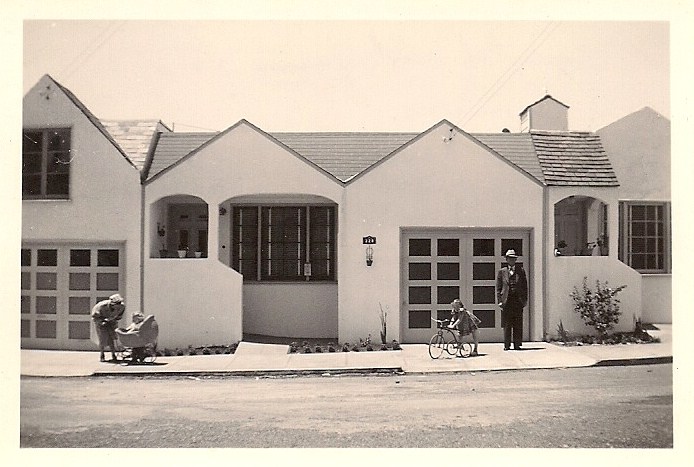
628 Hillside Blvd, Daly City, California
My great-grandparents, Belle & Jack Severin, with my mother and uncle.


Grandpa Dana's jobs were just as numerous:

I worked in hosiery awhile,
Then sold it on the road....

The old man sold potato chips,
This followed frozen food.
And then worked on the waterfront,
In a six month's interlude.

A purser with United
I was in '43.
we flew the South Pacific
Till it saw enough of me.

Then, into business for ourselves
With Kenny and with Lee,
In looking back it seems quite odd
We chose a grocery.


The grocery, G & M Grocery, on Foothill Blvd in Oakland, was a joint venture with Walter Rensch, and two relatives: John J Severin, and Kenneth E Richards, Grandpa's father-in-law and brother-in-law, respectively. I have not been able to discover what connection Rensch had to our family, except that he was a neighbor of my grandparents. There was also a pharmacy, Kay Dee Drug Stores, in Alameda owned by the foursome. In 1948, the grocery was sold entirely to Rensch, and Grandpa Dana and Kenny became the co-partners in Kay Dee.

Of course, it wasn't all work in the '40s. Grandpa was also a volunteer Civil Defense Warden, an award-winning member ("Trophies too, by gosh. That guy Dana!") of the East Oakland Racing Pigeon Club (he also raised pheasants and mandarin ducks), President of the East Bay Merchants Association and member of the Elmhurst Lions Club, and an amateur actor with the Oakland Community Players, appearing in such productions as Date with Judy, Goodbye Again, and as "the male lead in the psychological comedy-drama Guest in the House."


Note the autograph of Shirley Temple Agar [her then-husband] on the OCP card.


From a review by Harold Peterson, under the headline "Dana Brown Steals Show":

As a rule we do not like theatre drunks. They either overdraw their roles into messy caricature or underplay badly. However, Harvey Wilson, as acted by Dana Brown proved the exception. Mr. Brown pulled out all stops without overdoing the role and practically walked away with the second act.

DEB, standing on right,  and his supporting cast.


Yet despite all this activity, he is still thinking bigger: there is a reply from the Royal Siamese Embassy from 1948, referring his request to conduct some kind of business endeavor in Siam to another office. Whether through "partner complications," disappointment with his Siamese scheme, or just having been bitten by the acting bug and hoping to make it in Hollywood (as actor? songwriter? something!), the Browns uprooted--for the last time--and headed south, to Long Beach, California.

To be continued....