Showing posts with label Keepsakes. Show all posts

"It seems to me more than all the print I have read in my life"


The Internet is a tremendous--if perilous--resource for research, genealogy included. But there is much to be learned by venturing out, and something especially satisfying about visiting actual places that connect with your family history. With the rain coming down outside today, giving me an excuse to stay in and blog, I will set down some of the genealogical outings I've made in the last couple years.

While researching a maternal 3x great-grandfather on my grandmother's side, Frederick D Ketchum (6 Apr 1811 - 21 Jan 1888), about whom I have written often, I came across mention of a book, The Schooner La Petite: Journal of Captain Oscar B. Smithreprinted from "Inland Seas" in 1970. La Petite was one of the ships Grandpa Ketchum built. 

I found and purchased a copy--online--and promptly read it through, eagerly looking for bits about Frederick Ketchum. Alas, although he built the eponymous schooner, he does not figure into the book itself, a reprint of journals Capt Smith kept for several years during the late 1870s. Capt Smith (21 Sep 1835 - 14 Aug 1916), a longtime Huron, Ohio resident, does mention many other relations of mine, however, including George Cherry Ketchum (Frederick's oldest son); Minnetta Amelia Ketchum (George's daughter); James Vance Bennett (husband of Frederick's oldest daughter, Frances Mathilda, known as "Fannie,"), who owned docks on Mackinac Island; and even the Huron Lighthouse, run for many years by Minnetta's great-uncle, Richard Lloyd Mansell. 

"Inland Seas," the magazine that reprinted Smith's journal, was established in 1945 by the Great Lakes Historical Society. I figured a visit to their National Museum of the Great Lakes was in order. I emailed first, letting them know my particular interest in the museum and familial connection to the lakes. I was thrilled to receive a reply that said


Did you know we have the capstan cover to a ship named for Mr. Ketchum on display at the Museum of the Great Lakes? It might be something you are interested in. There is a also a small section about his involvement in Toledo shipping, etc. 

"Might be..."? How exciting! And Toledo? That was definitely new information about Frederick Ketchum. It was time to hit the road....


At the museum, excited about seeing Grandpa K's capstan.

Alas, when I got to the Museum, the aforementioned capstan cover was named for a different Ketchum--in fact, a Mr Ketcham. Toledo surprise, indeed. These near misses are becoming their own kind of family tradition....

Anyway. The museum is lovely, and we spent a couple very entertaining and informative hours admiring the exhibits.


Although the capstan cover was a disappointment, I was all the more surprised, then, to see they did have an interactive exhibit about La Petite, taken from Capt Smith's journal. The journal had led me to the museum, so it seemed the circle was complete, as round as a capstan cover, no matter to whom it belonged. 


Different virtual bookmarks led to different pages; 
this one featured a picture of the ship.


Before leaving Toledo, we also stopped at the Toledo Botanical Garden, which was gorgeous, despite some rain. I got a picture with a symbolic family tree to commemorate the outing.


Your humble blogger with "Monument to a Tree" (1994) by Carl Floyd.


Inspired by seeing second-hand information about my family, I wanted to see if I could get a bit closer. A few months later, another Road Trip was ready to roll. Next stop, Fort Wayne, Indiana. 

I began my trip at the Genealogy Center of the Allen County Public Library. It was a large, wonderful facility, but I did not learn a great deal there of note, in part because I wanted to move on and see sites associated with my family.

I headed out to Lindenwood Cemetery, to pay respect to my 1st cousin, 3x removed, Minnetta Amelia Ketchum (2 Jul 1865 - 25 Aug 1953) and her husband, Frank Bursley Taylor (23 Nov 1860 - 12 Jun 1938). You may remember her name from a few paragraphs ago. She is Frederick Ketchum's grand-daughter, and features in Capt Smith's journal; she was a playmate of his daughter.


Besides being buried in Fort Wayne, the Taylors lived there for many years, when not exploring the geology of the Great Lakes, which you can read more about here. Frank Taylor's parents moved to Fort Wayne in 1859, and soon became one of the prominent families. Robert Stewart Taylor (22 May 1838 - 28 Jan 1918) was first a lawyer, and later judge. The Pictorial History of Fort Wayne (B.J. Griswold, 1947) referred to Judge Taylor as "the dean of the bar of Allen County." He introduced a bill to bring streetcars to Fort Wayne, and ran--unsuccessfully--for Congress twice; in 1881 he was appointed by President Garfield to the Mississippi River Commission. 

Looking for the three homes the Taylor families owned in Fort Wayne over those years, I discovered that one was under a parking lot, ditto another, while the third was now just a vacant lot surrounded by houses. If nothing else, I wanted to imagine the tree was from their time, so I gave it a solemn pat and headed home.


Erstwhile Taylor home, and possible family tree.

My elusive ancestors.... I felt like I was getting closer, but still at a remove. Displays and empty lots are all well and good, but can't provide much context or elicit much feeling.

Itching to get on the road again, but not knowing to where, a little digging in another branch of the family tree, ancestors of my maternal grandfather this time, led me back to Indiana, to the magically named Spice Valley.

My Conley kin came here from Ireland, the first to emigrate being my 6x great-grandparents, John Conley, Senior (28 Jun 1744 - 24 Jul 1798) and his wife, Sarah Wilson (16 Apr 1746 - 12 Jun 1824), although they probably did not marry until they were in the US of A. I know little about them (whether they met here or in Ireland, for example) until after they arrived, when, like a good many Scotch-Irish, they settled in North Carolina.

Son John Conley, Junior (30 Aug 1776 - 31 Jan 1853) was born in North Carolina, where he married Catherine Miller (15 Oct 1782 - 5 Aug 1845) on 7 Mar 1799. Eighteen years--and eight children--later, following brother Josiah Connelly [sic] (21 Aug 1783 - 20 Feb 1870), they had left North Carolina for Indiana, landing in the nascent Lawrence County in 1817. 

The Conleys/Connellys, along with allied families, among them the Maxwells, Isoms, and Tollivers (all of whom are my ancestors), were a strong presence in the early years of the region. Josiah was the first constable of Spice Valley, others holding posts such as Overseer of the Poor, and School Superintendent. Another brother, Elijah Connelly (7 Jul 1779 - 28 Sep 1831), was the first deacon of the Spice Valley Baptist Church, established on 1 June 1822. The congregation met first in the barn of William Maxwell (1765 - 1832), a 5xgg, before a church was erected a few years later. Although the current church building is the third on that site, being built in 1888, the original cemetery behind it is filled with Conleys and Isoms.


It was fitting that I met my fifth cousin, twice removed, Susan there; she is descended from my ancestor John Conley's brother, the deacon Elijah Connelly. My excitement upon meeting her was tremendous, not just because I had driven around lost for an hour, but because she is the first relative I have met face-to-face through genealogy research, rather than knowing all my life.

We clicked instantly, and shared family stories, both pulling out charts to better see our connection. Then came the real treat: I followed her a few miles up the road to the farm that has been in our family for two hundred years.
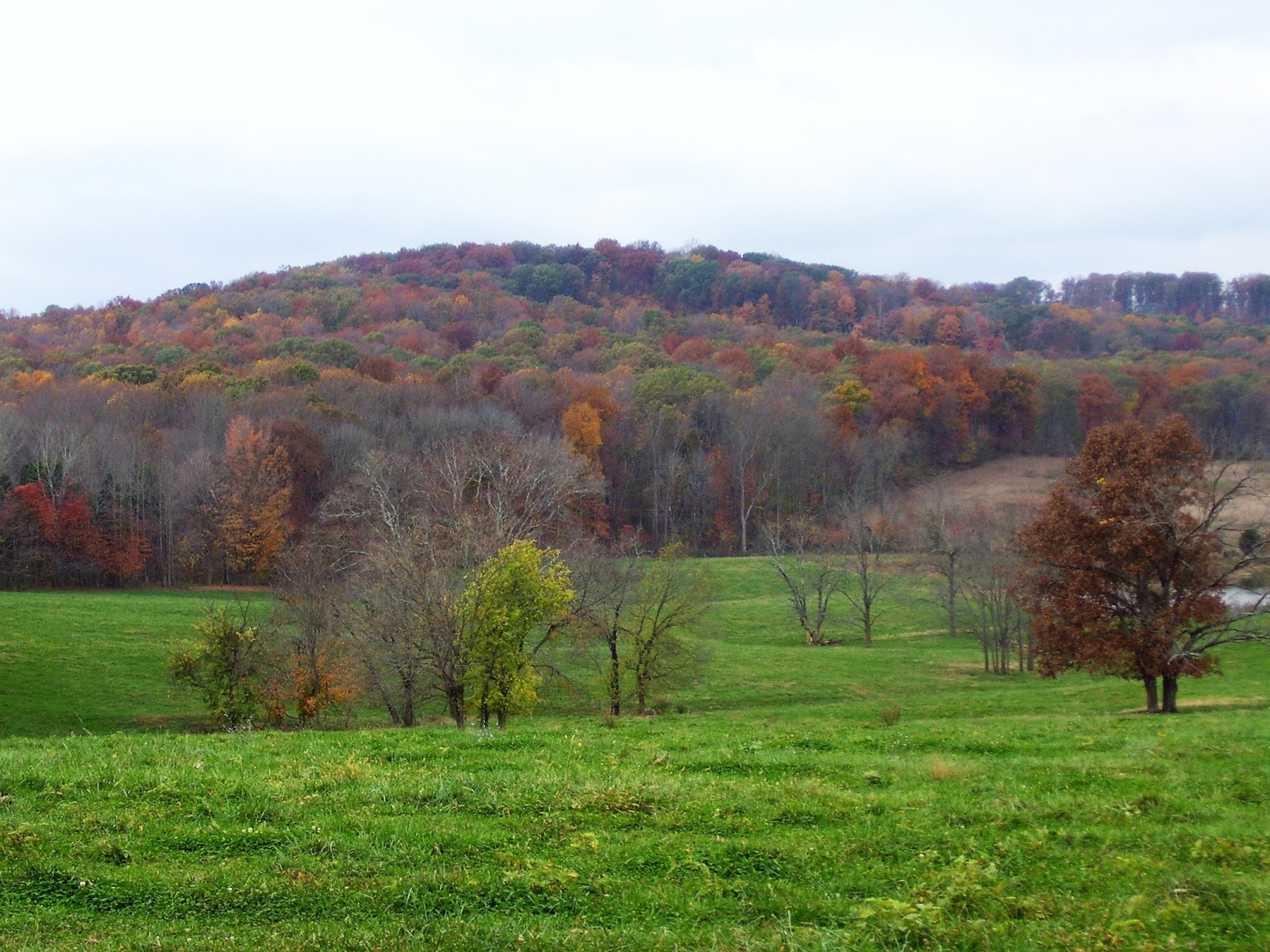

Conley farmland, Spice Valley.

The current farm is on land originally owned by John and Elijah's brother Joel Connelly (10 Mar 1788 - 8 Jun 1853). Although the Conley/Connellys and their in-laws owned much of the area, this parcel is the last to have stayed in the family, despite many of the pioneer Connellys deciding in the late 1830s to move further west to Clay County, Illinois. Family lore has it that the Connellys and their kin, always clannish, felt that too many newcomers were moving into their valley; that side of my family--down to myself--have always been a mix of gregariousness and the desire for near-hermitic privacy.

Anyway. Cousin Susan gave me a tour, of the property, which has been given a Hoosier Homestead Farm designation by the state of Indiana. 


[I was so excited, I did not get a picture of their sign on property;
this image--from a different farm--came from the web.]


We passed by a charming cabin, built in comparatively more recent years as a sort-of playhouse for the many boys in the family.


It had been raining, so we did not venture to the natural spring, but did pause for a picture by one of the barns.


I was captivated walking through fields that my family has walked for two hundred years. Pictures, exhibits, and stories are all wonderful, but there is something so forceful about really being there. Amidst a whirl of emotions, we reached our final destination, a small hilltop that is the resting place of many of our family. 

Although weathered with age, here was the headstone of our six-times great grandmother, Sarah Wilson, who came from Ireland to America in the 1700s, joined her family on their pioneering move to Indiana in the early 1800s, and finally came to rest here, in Spice Valley, in 1824.


Several other generations of Connellys join her on the hillside. I have visited grave sites before, but this was special, knowing that the view I had in all directions was one they had shared. 

Looming clouds and a long drive ahead meant it was time to say goodbye. Susan recommended I visit the  Connelly Cemetery in nearby Marion Township, but I decided to save that for next time.  We stopped and ate some windfall persimmons from an ancient-looking tree as the sky darkened. After a big hug from Susan, I got into the car, taking a few persimmons home with me. 


In part, I wanted to share some of the Conley persimmons with Stephen, who was not able to join me on this trip. But I also had another idea.... I saved some of the seeds, and planted them this spring. Who knows if I will ever get to taste my own home-grown Conley persimmons, but I can at least enjoy, no longer symbolic or supposed, my own little family tree. 


"...lightness and glee"

In this post we move from the sinister, sacred, and scientific of last time to simplicity and sisterhood: the Severin sisters of Fargo, North Dakota, circa 1930. One of those sisters would become my maternal grandmother: Myrna Margaret Severin.


Myrna Margeret Severin, 1930

My grandmother was born 5 November 1907, at least according to her Birth and Death Certificates. (Other documents list her birth date as the 6th.) She was born in Redfield, South Dakota, to Jack Severin, a tall Danish farmer, and Belle Runser; she was the youngest of their three daughters. She is nearly unique among my ancestors--going back to the late 1700s--in that three of her grandparents were immigrants: her father's parents, Jacob Soren Severin (31 Mar 1848 - aft 1920) and Anna Margrethe "Annie" Nissen (8 Dec 1851 or 2 - 2 Jan 1924) were Danish; her maternal grandfather, Phillip Jacob Runser (30 Jun 1845 - 22 Mar 1921) was from Hegenheim, in the Alsace-Lorraine region of France, on the border of Switzerland.


My grandmother with her grandfather; Myrna and Jacob Severin, c 1918?

Redfield itself was modest, and remains so. Founded in 1878, it was the County Seat for Spink County, located at the junction of two railroads; it was also the home of the Northern Hospital for the Insane (founded in 1902 and still running today under the more optimistic name South Dakota Developmental Center). Redfield did not achieve any real distinction until three pair of pheasants were released there, "near where the ethanol plant is currently," according to their Pheasantennial Celebration brochure--I kid you not.


Downtown Redfield--all of it--about the time the Severins lived there.

Since then, Redfield has prided itself on being the "Pheasant Capitol of the World" (so much so, that they have trademarked that slogan), and the pheasant has become the State Bird of South Dakota, one of just three states with a non-native species as such. The Pheasantennial occurred in 2008 (for any of you who were considering a trip), the release being in 1908, a year after my grandmother's birth and just a year or so before the Severins left Redfield for Crookston, Minnesota. 

The Severins at  E Holmes Street, Redfield, South Dakota, c. 1908
From left: unknown dog, Jack, Gleva, Lee, Belle, Myrna.
 Not pictured: pheasant.

The Severins at that time were comprised of Jack and Belle, and their aforementioned three daughters. Eldest was Gleva Marcella (15 Jan 1904 - 4 Aug 1982), fair and wistful, or so she seems from photographs; next was Arletha Monica, (13 Jan 1906 - 22 Aug 2002) known always as "Lee," with luxuriant dark hair; she rarely smiled, at least to gauge from the childhood pictures I have seen. Next was my grandmother, always cheerful-seeming (although in pictures from her late teens she often looks to be attempting a dramatic or sultry visage). Their unusual names seem to reflect their background, a mash up of Scandinavian and French.

There was also a son, Delmar J[?], who was born in September 1909 and died within a few years. I know nothing more about him, and often wonder, if he had lived, how our family might have been different.

From left, standing: Lee (smiling!), Gleva, Myrna; seated: Delmar.

I wonder about Delmar in part because my mother's side of the family was (and is) the side I know best, and it was definitely a matriarchy, in form if nothing else. For most of my childhood (with occasional interruption from my father's side), I had always thought of our family as just “the three Severin sisters,” each with their one or two children, each of those children with just one, two, or three themselves. The sisters were close; when my grandparents moved west, the rest of the family followed. Their husbands had businesses together, and we saw everyone at least once a year, usually at Thanksgiving. While growing up, although close, with such a small family our get-togethers seemed-- if only in numbers--somewhat meager affairs. Perhaps if our forebears had been Catholic rather than Presbyterian, things might have turned out differently…. And certainly different if little Delmar had lived.

Anyway. In Minneapolis, my grandmother attended school, and in 1924 the Severins moved again, this time to Fargo, North Dakota, where they lived at 910 College St. My grandmother graduated from Fargo Public High School on 4 June 1925; her diploma mentions her Literary studies. The following year, the family moved again, this time to 1020 N Thirteenth St.

It was that same year,1926, that my grandmother began keeping a diary, inspired by the discovery of a diary her mother had kept when she was young. Apparently her sister Lee was keeping one as well, to better effect, as Grandma's peters out after just fourteen days--with lapses! "Whether or not mine will be read some time in the future with any interest or not time will tell." Indeed.

Only a few pages long, there is not a lot of information (it is a hot summer, the piano is moved, sister Gleva is away from home but writes often, Lee and Grandma spend a day canning "pickels"), and just one bit of drama: returning from Crookston, Minnesota in their horse and wagon, her parents are nearly hit by a freight car that has gone off the tracks.  Her "literary" side comes out briefly: Lee asks if the author of The Snob (a sensational novel--and silent film that Lee had seen--from 1924) is a man or a woman, and Grandma retorts, "neither--a birdie." She may have been a bit snobbish herself, as she writes that Lee is "foolish" for asking.  But otherwise, it is a nice, albeit brief, glimpse into her life, and did afford one pleasant surprise: she is reading a book of essays, From a College Window, by A C Benson, a prolific but now long-forgotten author from a family of such, whose novelist brother, E F Benson, has long been one of my favorites!

Myrna continued her education; she received a two-year teaching degree from Moorhead [Minnesota] State Teaching College in June 1927, and was teaching in Estelline, South Dakota.
The diary was more interesting, at least, than an autograph book given her in 1928, when she had moved out to attend college. It is signed by many of her friends as well as former pupils. Highlights of that document include the repeated use of the jingle:
"When you see a monkey up in a tree,
Pull its tail and think of me."
And the perhaps telling:
Dear Miss Severn,
Some right for money
Some right for fame
But I simply right
To sine my name.
your pupil,
Zola E---
Possibly despairing of teaching, Myrna began her graduate work, this time at North Dakota State College (now University), and by 1930 had moved back home.


The 1930 Fargo Directory

It was at this time that she became co-owner and proprietor, with her sister Gleva, of LaPetite Art Shoppe. It was located at 316 Broadway, next door to the Fargo Theater, which was built in 1926 and, fully-restored, is still in operation today. Alas, LaPetite does not appear to have lasted long, as it is gone by the 1932 edition of the directory. Beyond this, I have no other information, despite researching through some excellent Fargo websites (see links), but yearn to know more! 


The Fargo Theater marquee is visible in the upper left. La Petite Art Shoppe was next door.

It is not surprising to know that the sisters ran an art "shoppe." My grandmother's highest grades on her 1925 report card were in Music, Drawing, and Watercolor. The sisters made their own clothes--which was common at the time, of course--but took great pride in their work, as evidenced by the photos below. They even made wedding dresses for their friends, and Gleva was working as an instructor at the Singer Sewing Machine Company in 1934.


Grandma modelling some of her (or Gleva's) creations. There are also photos of Gleva wearing these same clothes.
 On the back of the center photo is pencilled "Virginia Snow patterns," and "WDAY", a Fargo radio station. Why?
More colorful creations. Left: What I hope is Halloween, with Lee and Gleva.
Right: Grandma between two drabber, unknown friends.

The directory page shown above also indicates that Lee has continued her love of movies, as she is working as an usher at the Garrick Theater, Fargo's first and most lavish picture palace, just two blocks down Broadway from LaPetite. The Garrick was later converted into a department store, and has since been demolished.

While in college, Myrna joined the Gamma Phi Beta sorority, and became very involved in social activities through school, serving on various committees and attending numerous dances. 
Some of Grandma's dance cards. Clockwise from the top:
Epsilon of Alpha Gamma Rho Spring Formal, Crystal Ball Room, 7 May 1931;
 Beta Sigma Chapter of Kappa Psi Annual Spring Formal, Crystal Ballroom, 20 May 1932;
 Senior Ball, Class of 1932, North Dakota State College, Crystal Ballroom, 3 June 1932;
 15th Annual Military Ball, presented by M Company, 3rd Regiment, N D State College,
Crystal Ballroom (did you expect anything else?), 17 January 1930. 
Most of the dances were held at the Crystal Ballroom, the glamour spot of Fargo, hosting everyone from Lawrence Welk to, famously, Duke Ellington in 1940. From the dance cards, it appears the most noted name who performed when my grandmother attended was Bill Euren and His Collegians; Euren later was music director for NDSU from 1948 - 1968, and there is still an annual Music Fellowship given in his name.The ballroom itself occupied the upper floor of the Fargo City Auditorium, at the corner of First Avenue South and Broadway, not far from the Severins' home. The lower floor served as the National Guard Armory. Despite its dual-purpose functionality, it too was demolished, in 1962. 

Photo courtesy the Cass County Historical Society.
With my grandmother's stated aversion to pickels [sic], one wonders how she felt about the menu for the Spring Formal:
Fruit Salad       Water
Creamed Chicken on Rosettes
Potato Chips       Cucumber Pickles
Hot Buttered Rolls
Individual Washington Cream Pie
Coffee

Despite Fargo's big city trappings, its surroundings were still definitely rural. In a letter written for my grandparents' fiftieth anniversary, Grandma's lifelong friend and neighbor, Mabel Farden Nelson, shared memories:

All the good times on your farm, especially when we got snowed in and missed school. Your mom made corn fritters for us. Boy were they good!

...we couldn't wait to get to Aunt Polly's Slough for the first skating of the season.... When we returned there was a big "bread raiser" pan of popcorn.

How about the time the chickens roosted on top of Dad's Dodge--and when he started to drive off your folks yelled --Stop! Stop!

It was a long walk from M[oorhead] St[ate] C[ollege] to your home in Fargo. I guess we thought shoe leather was cheaper than streetcar fare.

How about the time we went "frogging" to get enough frog legs for Gleva to have the dinner party. We cried as we hit them with a stick cuz their front legs crossed like they were praying.

At any rate, it was not all frogging, art and gaiety; Myrna did graduate in 1934 with a Bachelor of Science, Education degree. By that point, she had also married my grandfather, and was expecting my mother, their first child. But that part of the story will have to be told another time.... 
 
On the back of another snapshot from this day is pencilled: "Our Happy Family 1934"
Lee, Gleva, Myrna, and (from left) their husbands:
 Thor Moe, Kenny Richards, and Dana Brown.

Nature or nurture? The question is an old one, with proponents on both sides. Considering the Severin sisters, certainly it seems a little of both. Out of their fifteen descendants (through two generations), fully a third were or are teachers; three work in the film industry; one has a sewing blog in which a Singer machine has pride of place.... Certainly, the apples did not fall far from the trees.

And then there is your humble blogger, who, while neither teacher, sewist, nor filmmaker, is fascinated by it all.


"A man who reads at all, reads just as he eats, sleeps, and takes exercise, because he likes it; and that is probably the best reason that can be given for the practice.”
                                                                       From a College Window, A C Benson


Myrna Margaret Severin was born 5 Nov 1907 (according to her Birth and Death Certificates; other records say 6 Nov) in Redfield, Spink, South Dakota, to John Jacob "Jack" Severin (11 Jul 1878 - 2 Jan 1965) and Isabelle "Belle" Runser (21 Oct 1881 - 30 Mar 1960). On 21 Oct 1933 she married Dana Earl Brown (26 Jan 1910 - 10 Sep 1984), son of Clarence Edgar Brown (1 Dec 1878 - 21 Aug 1937) and Cora Mabel Kinman (4 Sep 1876 - 22 Aug 1958), in Minneapolis, Minnesota, at the home of Iza May (Kinman) Carlson, the groom's aunt. Rev Porter, a retired Presbyterian minister officiated. The following year, on 15 Jun 1934, Myrna graduated with a Bachelor of Science, Education, degree from North Dakota Agricultural College, and two months after that, delivered her first child. The Browns moved to Northern California the following year, where Myrna worked as an elementary school teacher. She continued to work as teacher after their move to Long Beach, California in the early 1950s. Although in almost perfect physical health, she died 12 Jun 1997 after enduring many years of Alzheimer's disease.

"the effect upon me of my early life"

Last time, I wrote about people to whom I am distantly connected, and ended by mentioning Calvin Coolidge, with whom I seem to have nothing in common, except perhaps a love of dogs. Anyway....

Someone to whom I am closely related--and happily have a great deal in common with--is my maternal grandfather, Dana Earl Brown (26 Jan 1910 - 10 Sep 1984).


Dana Earl Brown c 1928

Googling his name reveals just one fact: he was an occasional lyricist, with three songs registered for copyright with the Library of Congress, all from 1939: Free, White, and 21, (music by Don Rodricks); I'll Never Let You Go (also with Rodricks, who has two other copyrights in 1934); and No  Shadows, (music by Harold Harvey). Aside from the potentially creepy nature of their titles, I have not been able to learn anything else about these songs, or Grandpa's collaborators. (Although there are at least three other Harold Harveys: one an early twentieth century lesser English painter; another a Hershey, Pennsylvania oncologist; and the last a sex offender and death row inmate in Florida. Harold Harvey was the occasional pseudonym of trumpeter Harry James, but I think they must have been different people.) Don Rodricks did provide the words for the song Treasure Island, (music by George Rex, 1938).

I have not been able to locate copies of these songs, but at least one was a (very) minor success; I have a royalty check for $1.58 from Davis and Schwegler. They are a mostly forgotten  music company, notable only for releasing early recordings of the Nat King Cole Trio. In the All Music Guide Review they are referred to as "a sleazy little fly-by-night outfit that soon went bankrupt."


The Internet not offering much, I am happy that there is a great amount of Grandpa Dana's life documented in photos, clippings, and letters that he saved, which I have been looking through with tremendous enjoyment.

He was born 26 January 1910 in Grand Forks, North Dakota, to Clarence Edgar Brown (1 Dec 1878 - 21 Aug 1937) and Coral Mabel Kinman (4 Sep 1876 - 22 Aug 1958). He was their second child, the first, Rex Hugh Brown (born 1 Jun 1905), dying at less than a year old. At the time of Dana's birth, his father was an Insurance Manager, a job he probably got from his father-in-law, William Edwin Kinman (Mar 1858 - 13 Jun 1925), who had a long career in that field. Clarence Brown changed jobs often, at other times being a clerk, salesman in a department store, and an advertising man for a printing company. This peripatetic approach to employment was something he would pass along to his son.

The Browns moved, first to Moorhead Minnesota, where another boy was added to the family: Ray Edgar Brown (2 Jul 1914 - 10 May 1980), then on to Minneapolis after 1915, where they finally stayed. Grandpa Dana attended Bryant Junior High, where he was Class President and served as Sports Editor of the Bryant Times, then Central High School, where he was active in tennis, basketball (breaking his collar bone in the process), and glee club, graduating in 1927. Around that time as well, he formed a musical duo with his best friend, Cliff Nash, performing at local amateur nights as "the Kinky Kids." One hopes the name was due to their curly hair, and not the material....


Sometime in the late 'twenties, the Browns moved back to Moorhead, Minnesota, and Grandpa Dana began attending Wheaton College (in Illinois), where he lettered in football and tennis, and again wrote for the school paper, offering up everything from hard reporting to groan-inducing jokes as filler. He also came in second place in the school talent show, with a poem called "Beauty." He did not graduate, returning to Moorhead by 1930, where he began courses with the Minnesota College of Law night school, to mixed results. Like his father, it seems he did not know what he wanted, or could not stick to one thing for very long, although the seeds of many of his life-long interests were already apparent: sports, writing, music, civic involvement, and bad jokes.

In January 1930, Grandpa received the following reply, from New Scotland Yard, London S.W. 1:


"Madam,
With reference to your letter of the 13th December, I am directed by the Commissioner of Police of the Metropolis to inform you that he regrets that he is unable to offer you an appointment in the Force, nor is he in a position to advise you as to any other employment in this country for which you may be suitable.
I am, Madam,
Your obedient Servant,
[signed] H G Gilbert"


Clearly the chaps at Scotland Yard  couldn't have been that good as detectives if they mistook Grandpa Dana for a woman. Although he must have attempted to clarify things, as there is another rejection dated just three weeks later, pointedly addressing him as "Sir." Although in that response they have his name as E. Dana Brown.

In May 1931, he received the following reply, from O. O. McIntyre, nationally known for his "New York Night and Day" daily syndicated column (reaching fifteen million readers as his peak), and a former publicist of Florenz Ziegfeld:


"Sorry, I already have a most satisfactory chauffeur. But, here's hoping you make a good columnist."

The brevity is not surprising, as McIntyre reportedly received three thousand letters a week from his fans (and--apparently--aspiring potential employees). McIntyre handled his correspondence and other writing from his bed, beginning after breakfast and continuing until early evening, always with the curtains drawn. He claimed he disliked sunshine.

Anyway. 1931 was a busy, if restless, year for Grandpa.  He was the Managing Editor and contributor to the newly-formed Fargo [North Dakota] News, a weekly newspaper serving the Fargo-Moorhead area. He was a Committeeman for Troop 39 of the Boy Scouts of America. He regularly submitted poems and song lyrics to places as diverse as Christian Business magazine and DeSylva, Brown & Henderson, the successful song publishers. With titles like "Longing," "Song of Melancholy," "Consolation," (from a woman's point of view and submitted as Diane E. Brown!), and "Lady Bugs & Dreams," it is perhaps not surprising that he received numerous rejections. Is it too much to think that the titles suggest his own unhappiness?

Also in 1931, he took a lengthy road trip to Hollywood, California, with another friend, Fred Cook, where they lived for two months before returning home. Although Grandpa kept an entertaining journal of their trip (including roadside tennis games while waiting for help with the inevitable breakdowns; numerous detours; and picking up an apparently never-quite-sober minister in Texas, who rode with them as far as Taos, New Mexico, before vanishing in the night...), he never explains his motives for going west, or what prompted his return.


At any rate, by late 1931, he had a job with the Strutwear Knitting Company, in accounting. Hardly the place for a man with big dreams. But there was more going on... and I will let Grandpa tell it in his own words, in a poem he wrote for my grandmother on their twenty-fifth anniversary:

The place was Minneapolis,
The time was '33.
A minister named Porter
Stood there with you and me.

And, as I slipped that flimsy ring
Upon your shaking hand,
There was no "Great Depression"
For we were feeling grand.

I didn't miss a day of work,
We needed every buck,
Just meeting you in '32
Was my best stroke of luck!

We didn't have much money,
So, we spent more time in bed
Than might have been the custom
If we'd been rich, instead.

So, it really wasn't surprising
That late in '34
We had our little Beverly
To fondle and adore.

And then, in 1935
We took our biggest journey
I chugged to San Leandro
With Beverly, and "Myrnie."


"Myrnie" was Myrna Margaret Severin (6 Nov 1907 - 12 Jun 1997), youngest of three daughters of John Jacob "Jack" Severin (11 Jul 1878 - 2 Jan 1965) and Isabelle "Belle" Runser (21 Oct 1881 - 30 Mar 1960). Grandma Myrna was born in Redfield, South Dakota, and by 1932 was living and teaching (having received a degree from Moorhead State Teachers College) in Fargo. I would love to know how my grandparents met; perhaps one clue is that Grandma's high school diploma recognizes her four years of literary study. Did they meet at a poetry reading? Had she seen something of his in the Fargo News?  It was a brisk courtship, as they were married the next year, on October 21 1933, in the home of Grandpa's aunt and uncle, by the aforementioned Rev Porter, a retired Presbyterian minister.

In 1934, my mother was born, and the following year led to another change in the Brown household. According to Elizabeth Faue, in the "Minneapolis Labor Review:"


In the summer of 1935, Farmer- Labor Party member Oscar Hawkins marveled at the happenings in Minneapolis. Everywhere, discontented workers brought the labor movement to life. Even the Strutwear Company, the public enemy of labor unions, was faced with a strike. As Hawkins reported, “the Strutwear Knitting Works had a sudden and lively strike ten days ago — still on. It is so hard to get the straight of the various conditions. The employers tell the newspapers their story... Stories of the workers are different.”


Although I have no record of my grandfather's participation--or not--in the strike, I do know his reaction: the Browns packed up and moved to northern California. The lived first in San Leandro, then San Francisco, where their second child, my uncle Bruce, was born, then Daly City, and finally, Oakland.


628 Hillside Blvd, Daly City, California
My great-grandparents, Belle & Jack Severin, with my mother and uncle.


Grandpa Dana's jobs were just as numerous:

I worked in hosiery awhile,
Then sold it on the road....

The old man sold potato chips,
This followed frozen food.
And then worked on the waterfront,
In a six month's interlude.

A purser with United
I was in '43.
we flew the South Pacific
Till it saw enough of me.

Then, into business for ourselves
With Kenny and with Lee,
In looking back it seems quite odd
We chose a grocery.


The grocery, G & M Grocery, on Foothill Blvd in Oakland, was a joint venture with Walter Rensch, and two relatives: John J Severin, and Kenneth E Richards, Grandpa's father-in-law and brother-in-law, respectively. I have not been able to discover what connection Rensch had to our family, except that he was a neighbor of my grandparents. There was also a pharmacy, Kay Dee Drug Stores, in Alameda owned by the foursome. In 1948, the grocery was sold entirely to Rensch, and Grandpa Dana and Kenny became the co-partners in Kay Dee.

Of course, it wasn't all work in the '40s. Grandpa was also a volunteer Civil Defense Warden, an award-winning member ("Trophies too, by gosh. That guy Dana!") of the East Oakland Racing Pigeon Club (he also raised pheasants and mandarin ducks), President of the East Bay Merchants Association and member of the Elmhurst Lions Club, and an amateur actor with the Oakland Community Players, appearing in such productions as Date with Judy, Goodbye Again, and as "the male lead in the psychological comedy-drama Guest in the House."


Note the autograph of Shirley Temple Agar [her then-husband] on the OCP card.


From a review by Harold Peterson, under the headline "Dana Brown Steals Show":

As a rule we do not like theatre drunks. They either overdraw their roles into messy caricature or underplay badly. However, Harvey Wilson, as acted by Dana Brown proved the exception. Mr. Brown pulled out all stops without overdoing the role and practically walked away with the second act.

DEB, standing on right,  and his supporting cast.


Yet despite all this activity, he is still thinking bigger: there is a reply from the Royal Siamese Embassy from 1948, referring his request to conduct some kind of business endeavor in Siam to another office. Whether through "partner complications," disappointment with his Siamese scheme, or just having been bitten by the acting bug and hoping to make it in Hollywood (as actor? songwriter? something!), the Browns uprooted--for the last time--and headed south, to Long Beach, California.

To be continued....

"Born here of parents born here from parents"

I celebrate myself, and sing myself,
And what I assume you shall assume,
For every atom belonging to me as good belongs to you.
I loafe and invite my soul,
I lean and loafe at my ease observing a spear of summer grass.
My tongue, every atom of my blood, form’d from this soil, this air,
Born here of parents born here from parents the same, and their parents the same,
I, now thirty-seven years old in perfect health begin,
Hoping to cease not till death.
Creeds and schools in abeyance,
Retiring back a while sufficed at what they are, but never forgotten,
I harbor for good or bad, I permit to speak at every hazard,
Nature without check with original energy.
                                                               --Walt Whitman (1819-1892)

It is not yet summer and I, now forty-nine years old, otherwise feel quite in accord with Mr Whitman.
His “Leaves of Grass” went through several iterations and perhaps this blog will too. At this point, my intention is to share stories about my ancestors, and my reactions to those stories. One of Whitman’s versions of his “Song of Myself” was divided into fifty-two parts, which neatly corresponds with the number of weeks in a year, a lovely echo of Time, and which appeals to my sense of structure, so I am planning to write fifty-two posts. Each post will focus on one family member, or at least use him or her as a jumping off point.
This being the last week of March, I am acutely aware of two things: that my mother died a year ago this month, and that my parents were married fifty years ago this month. (Those of you who know my birth date can see that this blog will not be entirely free from scandal….) Any kind of examination of my family begins here.


Body language?

My mother’s death was the catalyst for my reinterest in genealogy. After her death, while sorting through her things at my grandparents’ house, I discovered many photos, letters, etc., with which I was unfamiliar, which, perhaps naturally, got me thinking about family. When I got home, I pulled out an old binder I had with some early attempts at genealogy, then went online to learn more. From this was born a hobby (although the word seems hardly adequate, “obsession” being perhaps too strong), as well as this blog. Ironically, my mother took almost no interest in history or “the past” herself.
But she did like to tell stories. One story that she told at most family gatherings was about her banty rooster, Debbie, a family pet she had while growing up in Oakland, California, and which she apparently named herself, unaware that Debbie was a he-chicken. (Later, she owned a parakeet she named Jim Beam the Fifth, which she tried to “take for a walk” by tying a string to its leg, but that is another story….) While riding with the family to her grandparents’ house for Sunday dinner, she was quite sure she heard Debbie crowing, and looked back several times to see if he was following the car. Her parents convinced her she was imagining things, but she was quite sure she had heard Debbie.  The next day she was horrified to discover Debbie was missing. My grandfather assured her that Debbie must have gotten loose and run away, and that possibly my mother could have been right about thinking she had heard Debbie chasing the car. It was not until a few weeks later, discovering feathers in the trunk of the car, that she realized that Debbie had been the Sunday dinner. The story would always conclude with my mother jokingly saying that she would never forgive her parents for the deception. (Perhaps coincidentally, Stephen and I are going this afternoon to pick up chicks--meaning poultry--at the local farm supply, as we are going to attempt to keep chickens ourselves.)
Another of my mother’s childhood companions was Suzy, the doll. Happily, Suzy met with a better fate than Debbie, and still lives with me today, resting on a bureau.


Beverly and Suzy. Regrettably, there are no pictures of Debbie.


Beverly Alane Brown was born August 8, 1934, at 9:37 a.m. in the Swedish Hospital (six pounds, nine ounces, Dr C. O. Maland delivering) in Minneapolis, Minnesota, a fact she disputed, always claiming she was a California native. The family did move to Oakland, California when she was just a year old. She was christened by a Reverend Ratz on October 21, 1936 (her parents’ third anniversary). The Browns lived in the San Francisco bay area, then moved to Long Beach, California, when my mother was in her teens. She attended Wilson High School and Long Beach City College (noted mezzo-soprano Marilyn Horne was a sorority sister). Her first marriage was brief, and after moving back home, she worked for Shell Oil and later Proctor & Gamble, where she met my father, whom she married March 4, 1961. After moving to Fountain Valley, California in 1965, she became very active in the Friends of the Library and FV Women’s Club, for both of which organizations she served as President, among other roles. After living briefly in Ohio, the family (my sister having been born in 1969) returned to Fountain Valley, where my mother resumed volunteering, winning recognition as Citizen of the Year in 1990, due in part for having led a recall of the mayor the previous year. My parents divorced in 1983. In 2003, my mother moved into the house her parents had built in Long Beach, at which time she made the newly-formed Fountain Valley Police Department RSVP program her priority, receiving numerous recognitions for her leadership and the number of hours she volunteered. After her death, on March 7, 2010, the Police Department created an annual award in her name to recognize other individuals who follow her example by making a positive contribution to the city she loved.