Showing posts with label Newbury Massachusetts. Show all posts

"surly English pluck, and there is no tougher or truer..."

 After a lifetime of daydreaming and two years of understandable yet disappointing postponements, my husband and I should be making our first trip to the UK later this year--fingers crossed! Along with all of the usual sightseeing (and a few literary pilgrimages I want to make), we are also planning to visit places associated with some of my British ancestors.

I have a fair amount of British blood, my DNA results notwithstanding. Eight of my sixteen great-great grandparents have British roots, so half of my ancestry hails from the UK, a much larger percentage than any other country or region. But they didn't come here recently.  All of those families' arrivals in America predate the Revolutionary War, a timeframe for which records are often scarce or vague, online family trees frequently riddled with errors, either accidental or through wishful thinking. Who wouldn't want to be George Washington's 
many times over great-grandchild, or claim Henry VIII as "Great Grampa Tudor"?

For that reason, what records do exist have been pretty thoroughly vetted, particularly for those who have those famous names or titles. And of course, wealthy, educated families were more likely to have records beyond the usual birth and death certificates or marriage licenses, although many families from that era did not necessarily even record or keep those. Wills, dowries, land records, biographies, mentions in extant letters or diaries.... All of these, 
except in the luckiest of instances, are more likely the province of the distinguished or notorious than those forebears who were farmers or laborers.

Which leads me to Gateway Ancestors. Although actual numbers vary slightly, there are believed to be just a few hundred of them: European men and women who came to America during the Colonial Era with proven, documented connections to royalty or aristocracy. So if you can connect yourself--legitimately!-- to a Gateway Ancestor, you are descended from someone posh.

My gateway ancestor is Percival Lowell (1571 - 8 Jan 1664), one of my paternal 10x great-grandfathers. I blogged about him once before, back in 2013. In 2019 on a trip to New England, I visited his environs and final resting place in Newbury, Massachusetts.
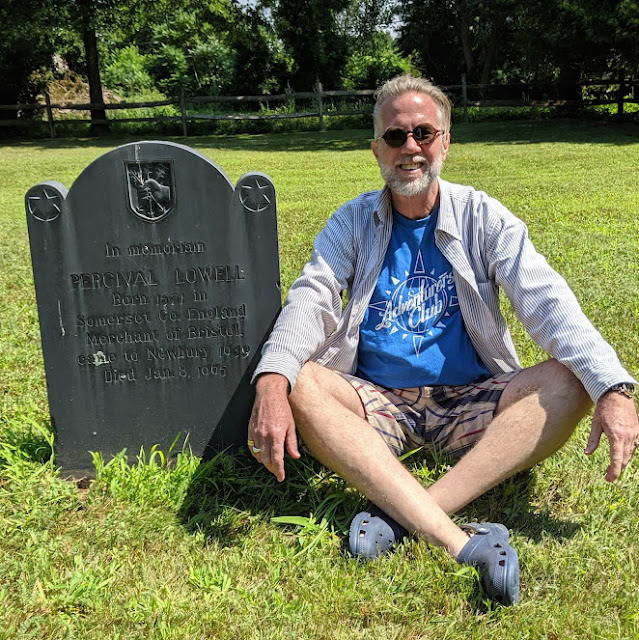

Burying Ground of the First Settlers, Newbury MA
Your Humble Blogger with the Commemorative Headstone for Percival Lowell.
Burying Ground of the First Settlers, Newbury MA, Aug 2019


In that earlier post I wrote that the Lowell family "was well-to-do; there is believed to have been aristocracy on both sides." Indeed. At the time of that earlier post I was just beginning genealogy, trying to work across my family tree, (grandparents first, then great-grandparents next, etc) rather than going straight back as far as I could through specific lines. By the time one reaches the 10x gg generation, we each of us have four thousand and ninety-six direct ancestors alone! It was a lot of work just getting that far, although, by no means do I know even half of their names. Remember all those record-less farmers and laborers? And researching back, I generally stopped once that ancestor "crossed the pond." It was enough of a learning curve to figure out the ins and outs of diverse American documents. Researching Europeans was work for a later date. And besides, an Ancestry.com World Membership ain't cheap.

Cut to today. I'm more skilled, and have done genealogy longer. I dig farther back, and in this case, had specific goals as I mentioned at the top: finding my British ancestors who might still have meaningful places to visit from their time. That's how I came to revisit Percival Lowell, who--at 68 years old!-- had emigrated with some of his family from Bristol, where he had been a successful merchant. A kind reply from the Research Room Co-Ordinator, Bristol & Avon Family History Society let me know that there was little of Bristol today that Percival would recognize, but was I aware that he was a Gateway....

So Grandpa Percy is my Gateway Ancestor, but gateway to whom? Heading onto Google, the first thing I came to was a fantastic (meaning well-researched and documented) website called the Magna Carte Project. Magna Carta! That is posh! And my Percival Lowell was descended from a--no, make that two--surety barons!

Which was thrilling, until I realized I didn't actually know that much about the Magna Carta, and certainly had no idea what a "surety baron" was.
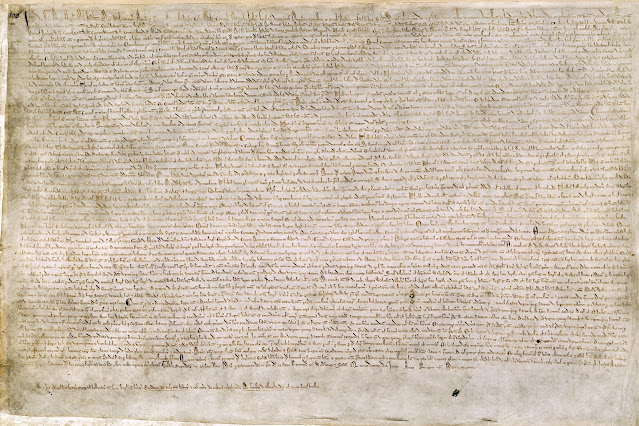

One of the few surviving copies of the Magna Carta.


Time for more research and reading.... As I often mention, one of the things I like best about genealogical research is how much more I learn about than just my own family. History, geography, different cultures and more. Anyway. I am certainly no expert, but after a few books and BritBox documentaries I feel I have at least a modest grasp of the Magna Carta and surety barons. 

To save you the trouble and keep things moving: there were twenty-five of those barons, and they were entrusted to ensure (hence "surety") that King John held to the terms of the Magna Carta, a document now considered the first constitution, from which almost all modern democracies descend. This "Great Charter" for the first time basically said a King is not above the law, creating a separation of powers; what we call the Executive and Judicial branches.

(Sometimes genealogy is not just about history, but also current events, alas. I told you it was educational....)

Anyway. Having learned all that, I returned to which barons, and how they fit into my family tree. Turns out they are both 24x great-grandfathers of mine, on Percival Lowell's maternal side: Robert de Vere, Third Earl of Oxford (c 1165 - 25 Oct 1221), and Sa[h]er de Quincey, First Earl of Winchester (c 1155 - 3 Nov 1219). I have to admit I was excited that one of 'em was named Robert. If you want to learn more about them and their other descendants, you can check out Burke's Peerage--or Wikipedia.

While I was learning about them, then adding their descendants and spouses' names and dates into my family tree, certain other surnames occurred and reoccurred: de Beaumont, de Bohun.... Apparently there was a lot of intermarriage back then. Flipping back and forth among these recurring names, I discovered that there was a third surety baron in my line through Percival Lowell: Henry de Bohun (1176 - 1 Jun 1220), First Earl of Hereford (and Constable of England), also a 24x great-grandfather.

I wrote the Magna Carta Project folks and asked why this was not in Percival's bio. Surely I was not the first to make this connection? No, it was known, and well-documented elsewhere. The Magna Carta Project volunteers work to prove at least one connection; the rest is up to you. Not unlike the Mayflower passengers, about whom I learned--and wrote about--earlier when finding those American ancestors, Medieval English aristocracy was a very closed society. In part because of all the intermarriage, if you were related to any one of them in either group you were almost certainly related to a few. In fact, it would be highly unusual to be related to just one! 
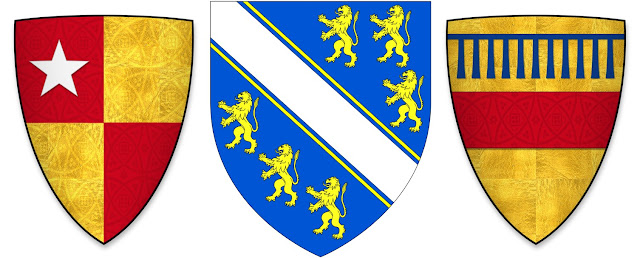

[Left to right] The coats of arms for the de Vere, de Bohun, and de Quincey families.
End images: Rs-nourse-Own work, CC BY-SA 3.0. Center image: Sodacan-Own work, CC BY-SA 3.0


Lovely as those coats of arms are, I am entitled to none of them. (Believe me, I checked.) They descend through male lines--as do the titles--and in fact, it was Percival Lowell's mother, Christian Percival (c 1549 - aft Jun 1577) who is my link to the nobility. The women in my family seem to be the ones who link back to fascinating subjects, whereas many of my male forebears are dead ends within a couple generations. Anyway.

Continuing to research and attempting to sketch in some of that noble, if confusing, lineage (so many Humphreys! So many earls!), I went back to the list of Gateway Ancestors, greedy for more. With so many ancestral names from the Colonial Era in my family tree, despite not knowing them all, I suspected I might find another Gateway. And there he was: Thomas Ligon (bef Jan 1624 - bef Mar 1676), who emigrated to Virginia in the 1640s. Ligon! I have Ligons/Lygons in my tree!

Shaking aside brief disappointment that Thomas Ligon was the gateway to a baron I already could claim, Henry de Bohun, I still wanted to see how Thomas fit in with my Ligons. It was through his 3x great-grandmother, Anne Beauchamp (c 1472 - 22 Jul 1534) that Thomas Ligon had the link to nobility. C'est toujours la femme, as my Norman ancestors might have said. So there's that. Although I already had Henry de Bohun (collect 'em all!), any disappointment soon passed part due to my next discovery.
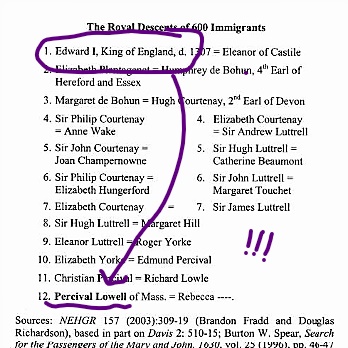

From "The Royal Descents of Six Hundred Immigrants," by Gary Boyd Roberts, 2006 ed.

Baron, schmaron... I'm a royal! A direct descendant of Edward I, old Longshanks himself, the Hammer of Scotland....

However. It is estimated that Edward I currently has a few hundred thousand living descendants. Twenty-odd generations adds up, particularly as many of the earliest noble kinsmen sometimes had multiple marriages, sometimes with a dozen children or so with each wife. And that's not even counting all the bastards....(Simple math, for those of you so inclined, should indicate numbers in the millions, but that doesn't account for pedigree collapse, exacerbated by all those aristocratic intermarriages.)  Whatever the actual number, I'm definitely not unique, so won't be busting out the strawberry leaves and ermine.

And now that I've reached royalty, yes, that means I am also descended from William the Conqueror and even Charlemagne, which personage I have only previously considered as a character in the musical Pippin.
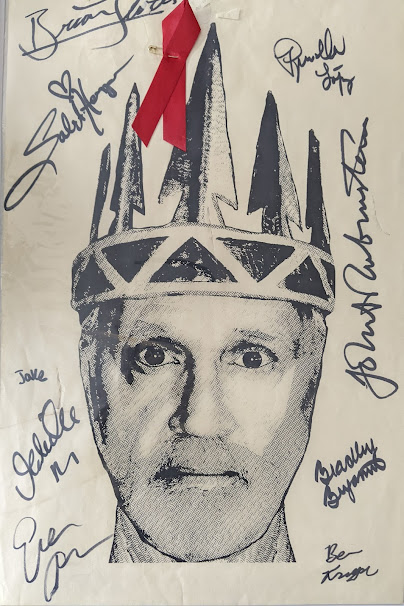

John Rubinstein as Charlemagne in the National Tour of the 2013 revival of Pippin.
Signed, stage-used prop to benefit BC/EFA from Your Humble Blogger's collection.

Charlemagne was not the only sovereign in my newly discovered family to be featured on stage and screen, of course. Bad King John, Edward I's grandfather (so my 23x gg) was the main character in the eponymous The Life & Death of King John, the earliest, chronologically, of the Histories purported to be written by William Shakespeare. I say purported because I now feel an obligation to stick up for Edward de Vere (12 April 1550 - 24 June 1604), a tenth cousin, fifteen times removed, as the more likely author. Family sticks together. 

Or not. King John, his brothers and parents (Henry II and Eleanor of Aquitaine, 24x ggs) are the subject of James Goldman's 1966 play and subsequent film The Lion in Winter. It concerns the plottings and machinations of nearly all the characters as they scheme to decide who should succeed Henry II, who at one point quips "I've snapped and plotted all my life. There's no other way to be a king, alive, and fifty all at the same time." While not entirely accurate historically, or perhaps because of that, the film has entered popular culture. The recent television series Empire is a modern spin on the same story.
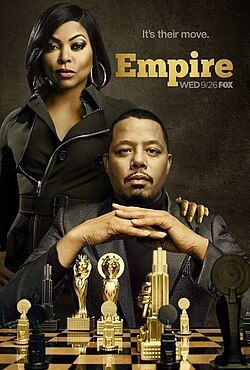

Taraji P Henson and Terrence Howard as Cookie & Lucious Lyon.
Ad for the fifth season of Empire.

I've added Empire to my watch list, along with screen versions of several Shakespeare deVere plays, and plan to rewatch both Ivanhoe and the Errol Flynn Robin Hood; the stack of library books on the Plantagenets and their times keeps growing. Pushpins on my map of England of places to visit on vacation are nearly crowding each other out as my plans keep growing while I continue to learn more.

To quote The Lion in Winter: "Kings, queens, knights everywhere you look and I'm the only pawn." 


"If you do not say any thing how can I say any thing?"

In her massive The Making of Americans (in itself a not-bad title for a genealogy blog...), the equally massive Gertrude Stein wrote: "I am writing for myself and strangers." I sometimes feel like that as well, although many of the strangers who come to this blog turn out to be cousins, happily, albeit distant ones. And there must be a fair number of you strangers out there: my total hits for March at this blog was over four hundred, a new record that almost doubled the previous month's, itself the brief all-time high. Thanks! 


Miss Stein, during her college years; a typical page from The Making of Americans.

This post, like several others, concerns New England, which is inevitable if one can go back far enough in one's family tree in this country, to the time and place of the Making of America. When I began this blog, it had not occurred to me I would be spending so much time Down East, or on the Cape, or in Beantown. It was one of those momentary, late-night mental lapses, like when I was so pleased I was fortunate enough to be descended from Mayflower passengers who survived....

Anyway. Boston makes me think of Harvard, which school Miss Stein attended; correctly, she attended the Harvard Annex, now Radcliffe, due to her gender. She studied psychology and philosophy under William James, among others, although she did not receive a degree.

     It was a very lovely spring day, Gertrude Stein had been going to the opera every night and going also to the opera in the afternoon and had been otherwise engrossed and it was the period of the final examinations, and there was the examination in William James' course. She sat down with the examination paper before her and she just could not. Dear Professor James, she wrote at the top of her paper. I am so sorry but really I do not feel a bit like an examination paper in philosophy to-day, and left.
     The next day she had a postal card from William James saying, Dear Miss Stein, I understand perfectly how you feel I often feel that myself. And underneath it he gave her work the highest mark in his course.

This famous anecdote is from The Autobiography of Alice B Toklas, written--tellingly--by Miss Stein herself. She later dropped out of Johns Hopkins medical school, stating simply that she was "bored." Harvard, of course, has produced many writers (well-known--and otherwise) who did graduate, among them John Collins Bossidy ("otherwise"), whose sole remembered literary legacy is the toast he gave in 1910 at one of his alumni dinners:

"And this is good old Boston,
The home of the bean and the cod,
Where the Lowells talk only to Cabots,
And the Cabots talk only to God."

I uncovered this bit of doggerel shortly after I discovered I was a Lowell, or rather, a Lowell descendant, from Percival Lowle (or Lowell), the first of the American Lowells. And what is behind Bossidy's toast? The Lowells (along with the Cabots, and--I suppose--others), were considered Boston Brahmins, an upper-class elite that constituted the "first families" of New England, and who, according to Wikipedia, "form an integral part of the historic core of the East Coast Establishment." Well then. Among the other forty-or-so Brahmin families are such familiar presidential names as Adams, Coolidge, Delano, and Quincy; other noted families like the Cabots, Forbes, Peabodys, Putnams, and such; and even a few that connote nothing (to me at least), like Saltonstall, Tarbox, and Wigglesworth, who, presumably, did talk to each other, if not to the rarefied Lowells.

In his seminal (if self-published) work, The Historic Genealogy of the Lowells of America 1639 - 1899, the author, the Rev Delmar R Lowell (with perhaps a bit of bias) wrote:

To do justice to the name of Lowell would require more than a moderate sized volume; a name not only distinguished in literature, theology and jurisprudence, but in all the relations of life.

In the words of another noted--if fictional--WASP: La di da, la di da, la la. But Rev Lowell has a point. A later Percival Lowell founded the Lowell Observatory; his brother Abbott was president of Harvard, his sister Amy was a Pulitzer Prize winning poet.

Like cousin Delmar, I will not attempt a "full history," but at least tell a little about the Lowell who got the whole ball rolling in the not-yet United States: Percival Lowle.

Percival was born in Somerset, England in 1571, where his Lowle forebears had lived for at least four hundred years. The family was well-to-do; there is believed to have been aristocracy on both sides. At any rate, by 1597 Percival was the Assessor in the village of Kingston-Seymour. He married his wife, Rebecca (whose last name has been lost to time) about 1599 (although records differ). Within a few years he was a prominent merchant in Bristol, running the firm Percival Lowle & Co. with his son John, and other family members. Then a remarkable thing happened:

In the year 1639 he cut asunder from all connections with England, and with his family, consisting of his wife, Rebecca, his two sons, John and Richard, his daughter Joane, and their respective families, and came to the Massachusetts colony and in June of 1639 settled at Newbury. 

The causes that led to the abandonment of his nativity, and to exile himself from the associations of a lifetime — the island home of a long line of distinguished ancestry — is a study of interest. He was then sixty-eight years of age. He had been successful even to opulence, and his age and circumstances would seem to have invited him to ease and retirement befitting his surroundings at Bristol.

Although accounts differ (boredom, money, a distaste for Charles I) as to what caused him to make this drastic and potentially dangerous change, most agree that John Winthrop, Governor of the Massachusetts Bay Colony, was looking for dependable, reputable people to settle in this troubled area and was able to persuade Lowell and family to make the voyage on the ship Jonathan. Certainly, the men were friends. Upon Winthrop's death, Percival wrote a lengthy poem, A Funeral Elegie, just two verses of which follow.

You English Mattachusians all
Forebear some time from sleeping.
Let everyone both great and small
Prepare themselves for weeping.

He was New England's Pelican
New England's Gubernator
He was New England's Solomon
New England's Conservator.

Although I have nowhere near the accomplishments of the varied Lowells (whose other descendants include everyone from T S Eliot to Tuesday Weld), perhaps there was one small legacy: it seems it is from poet Percival--a tenth great-grandfather--that I inherit my love of italics, which I use nearly as much as he did.


First Burying Ground, Newbury, Essex, Massachusetts.
The image at the top is a portion of the Lowell coat of arms.

Gertrude Stein again: "I love it and I write it. I want readers so strangers must do it." Don't be a stranger. Feel free to "Follow" this blog, or leave a comment. I'd love to hear from you.

Even if you're not a Cabot--or God.


1. Percival Lowle or Lowell (1571 - 8 Jan 1664) was born in Somerset, England, and married Rebecca LKU (1575- 28 Dec 1645), possibly in 1598 or 1599. They emigrated to the Massachusetts Colony in 1639, where they were among the founders of the town of Newbury.

2. John Lowell (? - 10 Jul 1647) emigrated with his parents, and once at Newbury, married Elizabeth Goodale (1620- 23 Apr 1651), daughter of John Goodale (1582- 7 Jul 1625) and Elizabeth Parlett (1584 -  8 Apr 1647), sometime between 1639 and 1641.

3. Benjamin Lowell (12 Sep 1642 - 22 Oct 1714) was, with his twin brother John (12 Sep 1642 - 25 Jul 1672), born in Newbury, Essex, Massachusetts, where he married Ruth Woodman (28 Mar 1646 - 22 Oct 1714), daughter of Edward Woodman (27 Dec 1606 - 17 May 1670) and Joanna Salway (1614 - 1687), on 17 October 1666.

4. Joseph Lowell (12 Sep 1680 - 8 Apr 1753) was also born, and died, in Newbury. It was also there that he married Mary Hardy (2 Feb 1693 - 4 Nov 1747), daughter of George Hardy (1660 - 6 Nov 1694) and Mary Fogg (1 May 1662 - 6 Nov 1694), on 6 December 1707.

5. Joseph Lowell (20 Feb 1720 - aft 1769) married Mary Jones (5 Feb 1726 - ?), daughter of Joseph Jones (1 Oct 1702 - ?) and Mary Prowse (26 Nov 1703 - 1783), on 11 January 1745, in Newbury, Essex, Massachusetts.

6. Hannah Lowell (23 Jan 1759 - Sep 1802) married Reuben Grindle (20 Mar 1757 - 15 Jul 1835), son of John Grindle (1 Aug 1714 - 1794) and Elizabeth Dorr (1727 - 12 Apr 1761), on 6 October 1777, in Penobscot, Hancock, Maine.

7. Deborah Grindle (25 Feb 1784 - aft 1860), married Isaac Burnett (1780 - May 1860), parents unknown, on 23 December 1802, in Hancock County, Maine.

8. Nathaniel S Burnett (12 Mar 1826 - 10 Oct 1885) married Rachel Elizabeth Squire (28 Jan 1829 - 21 Apr 1902), daughter of Samuel Squire (13 Apr 1797 - 26 Jul 1871) and Lovina Coleman (27 Oct 1806 - 2 Jul 1901), on 26 December 1850, in Hancock County, Maine.

9. Charles A Burnett (Feb 1856 - 17 Jan 1930) married Ella Swarts (1 Sep 1861 - Apr 1899), daughter of Charles Swarts (12 Feb 1835 - 8 Jan 1909) and Henrietta Davenport (Jan 1836 - May 1904), on 1 September 1879 (her eighteenth birthday), at Spring Lake, Minnesota.

10. Alfred Nathaniel Burnett (19 Aug 1883 - 31 Jul 1959) married Jennie Arleta Eaton (14 Mar 1891 - 15 Apr 1979), daughter of Dor Henry Eaton (May 1869 - 31 Dec 1945) and Anna B Miller (Jan 1867 - aft 1920), in 1909 in Minnesota.

11. Leroy Stanley Burnett (31 Aug 1910 - 11 May 1980) married Hazel Lucille Erickson (6 Sep 1910 - 6 May 2002), daughter of Erick Albert Erickson (28 Aug 1864 - 27 Nov 1948) and Johanna Maria "Marie" Svard (5 Feb 1875 - 28 Apr 1914),on 21 June 1933 in Minneapolis, Minnesota.

12. [Living] Burnett married Beverly Alane Brown (8 Aug 1934 - 7 Mar 2010), daughter of Dana Earl Brown (26 Jan 1910 - 10 Sep 1984) and Myrna Margaret Severin (6 Nov 1907 - 12 Jun 1997), on 4 March 1961 in Long Beach, California.

13. Your humble blogger.

"...one supposed it lucky to be born"

So the other day was my birthday, and at my age you don't make too much of it--although I did get a smashing donut "cake." As I was reading the morning paper (before it became too covered in chocolate and sprinkles to make out), my eye fell on the "Today in History" column, and later on the list of the day's celebrity birthdays. It was reasonably interesting to discover that in 1609 Henry Hudson began exploring the river that was later to bear his name, and that Elizabeth Barrett and Robert Browning chose to elope on "my day" in 1846. I have no idea who Yuto Nagatomo is, but it was nice to see that H. L. Mencken, Maurice Chevalier, Alfred A. Knopf, and Jesse Owens are all among my Virgo buddies. Apparently 12 September is also the feast days for several saints, including Ailbe of Emly (patron saint of wolves) AKA Saint Elvis (!), and Guy of Anderlecht (who protects against rabies). Fascinating.


Putting aside these strangers, I wondered who in my family tree shared my birthday; out of over four thousand people (albeit many of whose birth dates are unknown), I figured there had to be a few.

Reviewing the report I generated, I noticed that there were other events tied to 12 September as well: two deaths, Lillian Amelia Johnson, mother-in-law of a maternal first cousin, twice removed (26 Oct 1886 - 12 Sep 1977); and Robert Elmer Velin, father-in-law of a maternal first cousin, once removed (3 May 1916 - 12 Sep 1979). My birthday is also the death date of John Alden (15 Sep 1598 - 12 Sep 1687) of history and legend, who may be a paternal eleventh great-grandfather, although I am still verifying this.


A fictional representation of a feasible ancestor.

There has also been one marriage, that of Moses Steele (10 Sep 1745 - 9 Feb 1814), a maternal first cousin seven times removed, to a Lydia Campbell--or Gibson, records vary--(19 Sep 1776 - 7 May 1836), on 12 September 1805, in New Hampshire, just months after the death of his first wife, Abigail Codd (15 Dec 1751 - 24 Jan 1805). Miss Campbell being Mr Steele's second wife may explain the nearly twenty year age difference....

But back to the birthdays. More distant relations include Elizabeth Mott (12 Sep 1672 - 22 Mar 1749), a paternal ninth great grand-aunt (and one of five women by that name in the family), and Claire Elaine Runser (12 Sep 1929 - 4 Oct 1946), a maternal second cousin, once removed.

My only direct ancestors who share my birthday are actually father and son: Benjamin Lowell (12 Sep 1642 - 22 Oct 1714) and Joseph Lowell (12 Sep 1680 - 8 Apr 1753), paternal eighth and seventh great grandfather, respectively. In an odd coincidence, Benjamin died on the same date as my sister's birthday.

Benjamin Lowell was born in Newbury, Massachusetts, the son and grandson of two of the town founders: Percival Lowell (1571- 8 Jan 1664), who emigrated from England with his family, including son John Lowell (1595 - 10 Jul 1647), Benjamin's father. The family connections with Newbury run deep. Benjamin Lowell married Ruth Woodman (28 Mar 1646 - 22 Oct 1714), daughter of another town founder, Edward Woodman (27 Dec 1606 - 11 May 1670). There are excellent articles about John Lowell and Edward Woodman at the Newbury, Essex County, MA GenWeb site.

http://newbury.essexcountyma.net/lowell.htm
http://newbury.essexcountyma.net/woodman.htm


A vintage postcard of the Founder's Memorial, and a detail of one of the sides.


Somehow this post seems to have taken us quite a ways from my birthday, which when you get to be my age, might be just as well. Time for another donut.

1. Benjamin Lowell (12 Sep 1642 - 22 Oct 1714) was born in Newbury, Essex, Massachusetts, where he married Ruth Woodman (28 Mar 1646 - 22 Oct 1714) on 17 Oct 1666.

2. Joseph Lowell (12 Sep 1680 - 8 Apr 1753) was also born, and died, in Newbury. It was also there that he married Mary Hardy (2 Feb 1693 - 4 Nov 1747), daughter of George Hardy (1660 - 6 Nov 1694) and Mary Fogg (1 May 1662 - 6 Nov 1694), on 6 Dec 1707.

3. Joseph Lowell (20 Feb 1720 - aft 1769) married Mary Jones (5 Feb 1726 - ?), daughter of Joseph Jones (1 Oct 1702 - ?) and Mary Prowse (26 Nov 1703 - 1783), on 11 Jan 1745, in Newbury, Essex, Massachusetts.

4. Hannah Lowell (23 Jan 1759 - Sep 1802) married Reuben Grindle (20 Mar 1757 - 15 Jul 1835), son of John Grindle (1 Aug 1714 - 1794) and Elizabeth Dorr (1727 - 12 Apr 1761), on 6 Oct 1777, in Penobscot, Hancock, Maine.

5. Deborah Grindle (25 Feb 1784 - aft 1860), married Isaac Burnett (1780 - May 1860), parents unknown, on 23 Dec 1802, in Hancock County, Maine.

6. Nathaniel S Burnett (12 Mar 1826 - 10 Oct 1885) married Rachel Elizabeth Squire (28 Jan 1829 - 21 Apr 1902), daughter of Samuel Squire (13 Apr 1797 - 26 Jul 1871) and Lovina Coleman (27 Oct 1806 - 2 Jul 1901), on 26 Dec 1850, in Hancock County, Maine.

7. Charles A Burnett (Feb 1856 - 17 Jan 1930) married Ella Swarts (1 Sep 1861 - Apr 1899), daughter of Charles Swarts (12 Feb 1835 - 8 Jan 1909) and Henrietta Davenport (Jan 1836 - May 1904), on 1 Sep 1879 (her eighteenth birthday), at Spring Lake, Minnesota.

8. Alfred Nathaniel Burnett (19 Aug 1883 - 31 Jul 1959) married Jennie Arleta Eaton (14 Mar 1891 - 15 Apr 1979), daughter of Dor Henry Eaton (May 1869 - 31 Dec 1945) and Anna B Miller (Jan 1867 - aft 1920), in 1909 in Minnesota.

9. Leroy Stanley Burnett (31 Aug 1910 - 11 May 1980) married Hazel Lucille Erickson (6 Sep 1910 - 6 May 2002), daughter of Erick Albert Erickson (28 Aug 1864 - 27 Nov 1948) and Johanna Maria "Marie" Svard (5 Feb 1875 - 28 Apr 1914),on 21 Jun 1933 in Minneapolis, Minnesota.

10. [Living] Burnett married Beverly Alane Brown (8 Aug 1934 - 7 Mar 2010), daughter of Dana Earl Brown (26 Jan 1910 - 10 Sep 1984) and Myrna Margaret Severin (6 Nov 1907 - 12 Jun 1997), on 4 Mar 1961 in Long Beach, California.

11. Your humble blogger.