Showing posts with label Lygon. Show all posts

"surly English pluck, and there is no tougher or truer..."

 After a lifetime of daydreaming and two years of understandable yet disappointing postponements, my husband and I should be making our first trip to the UK later this year--fingers crossed! Along with all of the usual sightseeing (and a few literary pilgrimages I want to make), we are also planning to visit places associated with some of my British ancestors.

I have a fair amount of British blood, my DNA results notwithstanding. Eight of my sixteen great-great grandparents have British roots, so half of my ancestry hails from the UK, a much larger percentage than any other country or region. But they didn't come here recently.  All of those families' arrivals in America predate the Revolutionary War, a timeframe for which records are often scarce or vague, online family trees frequently riddled with errors, either accidental or through wishful thinking. Who wouldn't want to be George Washington's 
many times over great-grandchild, or claim Henry VIII as "Great Grampa Tudor"?

For that reason, what records do exist have been pretty thoroughly vetted, particularly for those who have those famous names or titles. And of course, wealthy, educated families were more likely to have records beyond the usual birth and death certificates or marriage licenses, although many families from that era did not necessarily even record or keep those. Wills, dowries, land records, biographies, mentions in extant letters or diaries.... All of these, 
except in the luckiest of instances, are more likely the province of the distinguished or notorious than those forebears who were farmers or laborers.

Which leads me to Gateway Ancestors. Although actual numbers vary slightly, there are believed to be just a few hundred of them: European men and women who came to America during the Colonial Era with proven, documented connections to royalty or aristocracy. So if you can connect yourself--legitimately!-- to a Gateway Ancestor, you are descended from someone posh.

My gateway ancestor is Percival Lowell (1571 - 8 Jan 1664), one of my paternal 10x great-grandfathers. I blogged about him once before, back in 2013. In 2019 on a trip to New England, I visited his environs and final resting place in Newbury, Massachusetts.
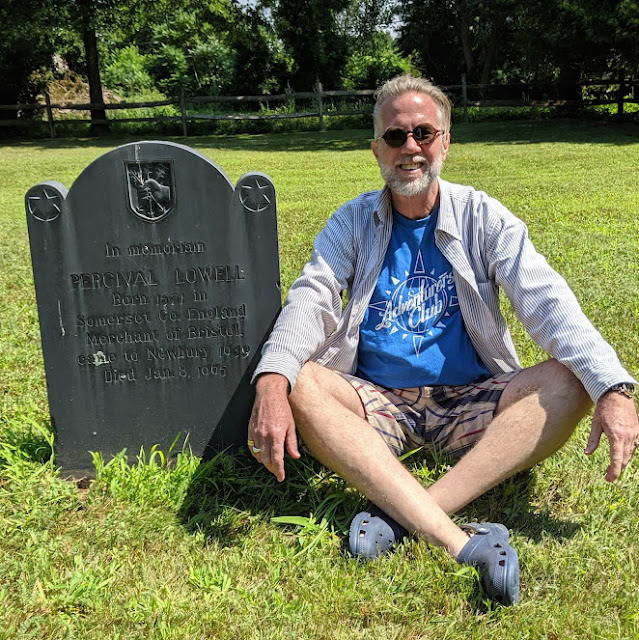

Burying Ground of the First Settlers, Newbury MA
Your Humble Blogger with the Commemorative Headstone for Percival Lowell.
Burying Ground of the First Settlers, Newbury MA, Aug 2019


In that earlier post I wrote that the Lowell family "was well-to-do; there is believed to have been aristocracy on both sides." Indeed. At the time of that earlier post I was just beginning genealogy, trying to work across my family tree, (grandparents first, then great-grandparents next, etc) rather than going straight back as far as I could through specific lines. By the time one reaches the 10x gg generation, we each of us have four thousand and ninety-six direct ancestors alone! It was a lot of work just getting that far, although, by no means do I know even half of their names. Remember all those record-less farmers and laborers? And researching back, I generally stopped once that ancestor "crossed the pond." It was enough of a learning curve to figure out the ins and outs of diverse American documents. Researching Europeans was work for a later date. And besides, an Ancestry.com World Membership ain't cheap.

Cut to today. I'm more skilled, and have done genealogy longer. I dig farther back, and in this case, had specific goals as I mentioned at the top: finding my British ancestors who might still have meaningful places to visit from their time. That's how I came to revisit Percival Lowell, who--at 68 years old!-- had emigrated with some of his family from Bristol, where he had been a successful merchant. A kind reply from the Research Room Co-Ordinator, Bristol & Avon Family History Society let me know that there was little of Bristol today that Percival would recognize, but was I aware that he was a Gateway....

So Grandpa Percy is my Gateway Ancestor, but gateway to whom? Heading onto Google, the first thing I came to was a fantastic (meaning well-researched and documented) website called the Magna Carte Project. Magna Carta! That is posh! And my Percival Lowell was descended from a--no, make that two--surety barons!

Which was thrilling, until I realized I didn't actually know that much about the Magna Carta, and certainly had no idea what a "surety baron" was.
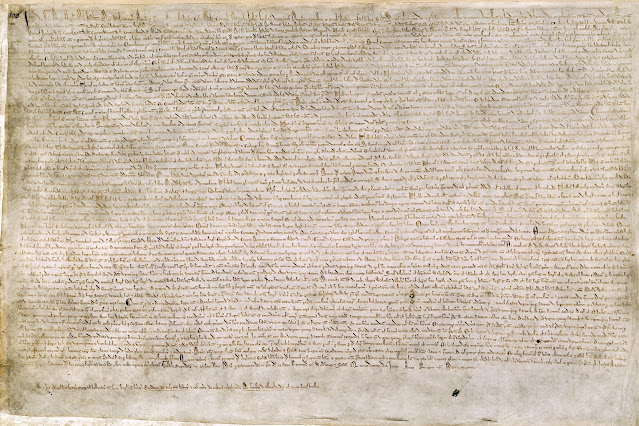

One of the few surviving copies of the Magna Carta.


Time for more research and reading.... As I often mention, one of the things I like best about genealogical research is how much more I learn about than just my own family. History, geography, different cultures and more. Anyway. I am certainly no expert, but after a few books and BritBox documentaries I feel I have at least a modest grasp of the Magna Carta and surety barons. 

To save you the trouble and keep things moving: there were twenty-five of those barons, and they were entrusted to ensure (hence "surety") that King John held to the terms of the Magna Carta, a document now considered the first constitution, from which almost all modern democracies descend. This "Great Charter" for the first time basically said a King is not above the law, creating a separation of powers; what we call the Executive and Judicial branches.

(Sometimes genealogy is not just about history, but also current events, alas. I told you it was educational....)

Anyway. Having learned all that, I returned to which barons, and how they fit into my family tree. Turns out they are both 24x great-grandfathers of mine, on Percival Lowell's maternal side: Robert de Vere, Third Earl of Oxford (c 1165 - 25 Oct 1221), and Sa[h]er de Quincey, First Earl of Winchester (c 1155 - 3 Nov 1219). I have to admit I was excited that one of 'em was named Robert. If you want to learn more about them and their other descendants, you can check out Burke's Peerage--or Wikipedia.

While I was learning about them, then adding their descendants and spouses' names and dates into my family tree, certain other surnames occurred and reoccurred: de Beaumont, de Bohun.... Apparently there was a lot of intermarriage back then. Flipping back and forth among these recurring names, I discovered that there was a third surety baron in my line through Percival Lowell: Henry de Bohun (1176 - 1 Jun 1220), First Earl of Hereford (and Constable of England), also a 24x great-grandfather.

I wrote the Magna Carta Project folks and asked why this was not in Percival's bio. Surely I was not the first to make this connection? No, it was known, and well-documented elsewhere. The Magna Carta Project volunteers work to prove at least one connection; the rest is up to you. Not unlike the Mayflower passengers, about whom I learned--and wrote about--earlier when finding those American ancestors, Medieval English aristocracy was a very closed society. In part because of all the intermarriage, if you were related to any one of them in either group you were almost certainly related to a few. In fact, it would be highly unusual to be related to just one! 
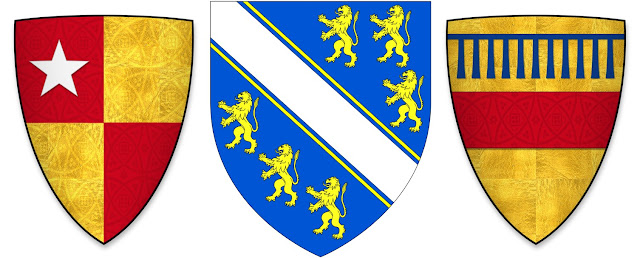

[Left to right] The coats of arms for the de Vere, de Bohun, and de Quincey families.
End images: Rs-nourse-Own work, CC BY-SA 3.0. Center image: Sodacan-Own work, CC BY-SA 3.0


Lovely as those coats of arms are, I am entitled to none of them. (Believe me, I checked.) They descend through male lines--as do the titles--and in fact, it was Percival Lowell's mother, Christian Percival (c 1549 - aft Jun 1577) who is my link to the nobility. The women in my family seem to be the ones who link back to fascinating subjects, whereas many of my male forebears are dead ends within a couple generations. Anyway.

Continuing to research and attempting to sketch in some of that noble, if confusing, lineage (so many Humphreys! So many earls!), I went back to the list of Gateway Ancestors, greedy for more. With so many ancestral names from the Colonial Era in my family tree, despite not knowing them all, I suspected I might find another Gateway. And there he was: Thomas Ligon (bef Jan 1624 - bef Mar 1676), who emigrated to Virginia in the 1640s. Ligon! I have Ligons/Lygons in my tree!

Shaking aside brief disappointment that Thomas Ligon was the gateway to a baron I already could claim, Henry de Bohun, I still wanted to see how Thomas fit in with my Ligons. It was through his 3x great-grandmother, Anne Beauchamp (c 1472 - 22 Jul 1534) that Thomas Ligon had the link to nobility. C'est toujours la femme, as my Norman ancestors might have said. So there's that. Although I already had Henry de Bohun (collect 'em all!), any disappointment soon passed part due to my next discovery.
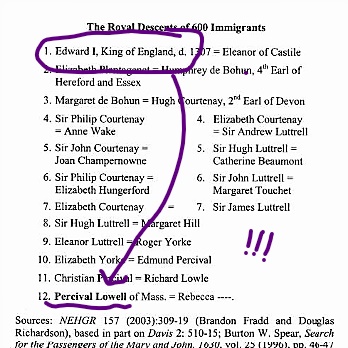

From "The Royal Descents of Six Hundred Immigrants," by Gary Boyd Roberts, 2006 ed.

Baron, schmaron... I'm a royal! A direct descendant of Edward I, old Longshanks himself, the Hammer of Scotland....

However. It is estimated that Edward I currently has a few hundred thousand living descendants. Twenty-odd generations adds up, particularly as many of the earliest noble kinsmen sometimes had multiple marriages, sometimes with a dozen children or so with each wife. And that's not even counting all the bastards....(Simple math, for those of you so inclined, should indicate numbers in the millions, but that doesn't account for pedigree collapse, exacerbated by all those aristocratic intermarriages.)  Whatever the actual number, I'm definitely not unique, so won't be busting out the strawberry leaves and ermine.

And now that I've reached royalty, yes, that means I am also descended from William the Conqueror and even Charlemagne, which personage I have only previously considered as a character in the musical Pippin.
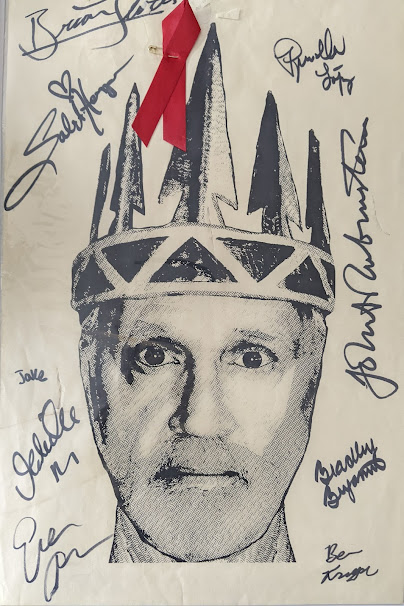

John Rubinstein as Charlemagne in the National Tour of the 2013 revival of Pippin.
Signed, stage-used prop to benefit BC/EFA from Your Humble Blogger's collection.

Charlemagne was not the only sovereign in my newly discovered family to be featured on stage and screen, of course. Bad King John, Edward I's grandfather (so my 23x gg) was the main character in the eponymous The Life & Death of King John, the earliest, chronologically, of the Histories purported to be written by William Shakespeare. I say purported because I now feel an obligation to stick up for Edward de Vere (12 April 1550 - 24 June 1604), a tenth cousin, fifteen times removed, as the more likely author. Family sticks together. 

Or not. King John, his brothers and parents (Henry II and Eleanor of Aquitaine, 24x ggs) are the subject of James Goldman's 1966 play and subsequent film The Lion in Winter. It concerns the plottings and machinations of nearly all the characters as they scheme to decide who should succeed Henry II, who at one point quips "I've snapped and plotted all my life. There's no other way to be a king, alive, and fifty all at the same time." While not entirely accurate historically, or perhaps because of that, the film has entered popular culture. The recent television series Empire is a modern spin on the same story.
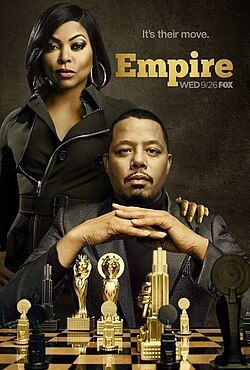

Taraji P Henson and Terrence Howard as Cookie & Lucious Lyon.
Ad for the fifth season of Empire.

I've added Empire to my watch list, along with screen versions of several Shakespeare deVere plays, and plan to rewatch both Ivanhoe and the Errol Flynn Robin Hood; the stack of library books on the Plantagenets and their times keeps growing. Pushpins on my map of England of places to visit on vacation are nearly crowding each other out as my plans keep growing while I continue to learn more.

To quote The Lion in Winter: "Kings, queens, knights everywhere you look and I'm the only pawn." 


"Writing and talk do not prove me"

The other day--for the first time ever, apparently--we celebrated two very American traditions on the same date: Groundhog Day and the Super Bowl. And by "we," I do not mean me. So while most eyes were on one of those events or other, I was thinking about other things, hovering around the concepts of family and identity.

Of course, those national obsessions are not unlike some aspects of genealogy. If Family-History Phil sees his document, it means one thing; if he doesn't, it means another six weeks of research. Super-Fan Fran roots for "her" team, a grouping of people she's never met to whom she feels a strong connection, who in reality may not be very different than that other group; occasionally a person might even leave one to join the other.


Perhaps the only other simultaneous occurrence of  Groundhogs and football;
Rudy Vallee and Robert Morse cheering on "Grand Old Ivy" from the film
How to Succeed in Business Without Really Trying, 1967. 

Part of the reason I was thinking about all this was because recently I received an email from someone hoping I could help them provide some proof to accompany a lineage society membership request. So although descendants of John Wallace Cherry (27 May 1788 - 10 Feb 1857), a maternal fourth great-grandfather, are already eligible to join the Sons of the American Revolution (John Wallace being a son of Capt Samuel Cherry), it seems those D A R gals don't mess around. They want proof, and very specific proof at that.

It seems too facile, somehow, that a single piece of paper could carry such weight. Marriage certificates, adoption papers... do they make a family? Is someone "less related" by the absence of a document? What if proof--in the form of a document or some other tangible evidence--cannot be provided for something that is otherwise demonstrably true? (And somehow, this post is shifting into territory I absolutely wish to avoid concerning this month's other news-ready--I was going to say "newsworthy" but thought better of it--event, the Bible v Science debate held just across the river.)

Anyway. It is interesting in genealogy (and elsewhere) how one's perspective can shift with a single piece of information; things you think you know suddenly become different.

I am reminded of Walker Percy's Lost in the Cosmos, in which he writes:

You are an Aries. You open your newspaper to the astrology column and read an analysis of the Aries personality. It says, among other things:

You have the knack of creating an atmosphere of thought and movement, unhampered by petty jealousies. But you have the tendency to scatter your talents to the four winds.

Hm, you say, quite true. I'm like that.

Suddenly you realize you've made a mistake. You've read the Gemini column. So you go back to Aries:

Nothing hurts you more than to be unjustly mistreated or suspected. But you have a way about you, a gift for seeing things through despite all obstacles and distractions. You also have a desperate need to be liked. So you have been wounded more often than you admit.

Hm, you say, quite true. I'm like that.

One of my ancestors, a son of the aforementioned John Wallace Cherry, had a son of his own whose birthplace and age did not make sense in the context of the family. Researching the Cherrys, I found by chance the explanation, a single mention in one obituary: "during his middle life Mr Cherry adopted a son." None of the other obituaries or documents mentioned that. Here was a shift, brought about by one piece of paper, one fact. The son was this, now he is that.

I have found myself caught up in the minutiae of my family's histories, or the thrill of discovering a famous or noted ancestor, or the excitement of seeing a photograph or locale connected with someone in my family...! And then I realize there was an error, a flaw in logic, a mistake. The thrill is substituted (after a suitable period of adjustment) by apathy. This occurred to me again the other day as I went trampling over and across other people's gravesites looking for the important ones: my family. This plot brings tears, this one is just in the way. "I, me, mine" indeed.

Percy's astutely astrological observation further reminds me of another bit: Laurie Anderson's recurring theme of being in the wrong house, used in several of her performance pieces. Here it is from "Talk Normal":

I came home today and both our cars were gone. And there were all these new pink flamingos arranged in star patterns all over the lawn. Then I went into the kitchen and it looked like a tornado had hit. And then I realized I was in the wrong house. 


The piece ends with the repeated plea "Look at me! Look at me!"

We all want to be seen, to be known for who we are. A larger context, like a family, can often help. Who is Clarissa Adams (31 Jan 1791 - 7 Feb 1872)? She is a maternal fourth great grandmother. She is the wife of John Wallace Cherry. She is the mother and adoptive grandmother of the fellas mentioned above. She is also one of my most vexing brick walls. By chance, I discovered a single document the other day, a query on a genealogy website, that opened up more of her identity. I now know she was a sister as well, to Betsey Adams (10 Oct 1788 - 25 Oct 1869), Sarah "Sally" Adams (31 Dec 1795 - ?), and James A Adams (abt 1800 - 9 Sep 1865). Might I be able to find out more, including who her parents were? With glee, I noted the name of the person who submitted the query, Naomi C Dryden, to contact her. Another document, another fact, another emotion: an online obituary from 2012. R I P Mrs Dryden, and thank you for the lead.

(Poking about, looking for that one piece of paper, that one proof of who Clarissa's parents might be, I discovered that her brother James' son, James Walton Adams [28 Dec 1838 - 18 Jul 1915], married a Eunice Waugh [31 Oct 1841 - 9 Dec 1924]. Waugh! Could this be another favorite author to whom I'm distantly related by marriage? A superficial study suggests so. Why spoil the delightful possibility with proof?]


Cousin Evelyn, as I like to remember him.


Family can help identify us, surely, but only within a group or social structure, not as individuals. Family also helps us form our identity, of course, through some admixture of nature and nurture. But how do we know who we are? Gertrude Stein (to whom it is doubtful I could be related, but...), wrote often about identity, particularly after she achieved widespread fame in 1934 with The Autobiography of Alice B Toklas. She meditated and composed on the theme of the disparity between how one sees oneself versus how one is seen by others. Some of these ruminations appeared in her 1936 The Geographical History of America, or the Relation of Human Nature to the Human Mind, in which she wrote the much-quoted phrase "I am I because my little dog knows me."

Beyond that bit of--dare I say--existential doggerel, though, are deeper concerns. She goes on to wonder who she would be if her dog did not know her, or who she is when her dog is not there to know her, and if either make any difference as to who she is. She concludes: "That does not prove anything about you it only proves something about the dog."


Gertrude Stein and her not-so little dog, Basket,
in a photograph by Man Ray from 1926.


You would think that after an entire book (and many other writings, including the extraordinary Ida: a Novel, which I can highly recommend to anyone interested in beginning with the more accessible--comparatively--Stein) about identity, she would have exhausted the topic, as she perhaps sometimes exhausted her readers. But Gertrude, having taken ahold of an idea, in doglike fashion liked to worry it like a bone, and added this in 1937:

Identity is funny being yourself is funny as you are never yourself to yourself except as you remember yourself and then of course you do not believe yourself.

All this speculation, this circling round family and identity, facts and proof. Have I come to any conclusions? Perhaps. But all that could change with a single piece of paper.

UPDATE 2020:

While skimming Facebook this morning, one of the genealogy groups I'm in had a link to an article about ships arriving in Newbury, Massachusetts and other colonial ports in the 1600s. Perhaps needless to say, none of my ancestors appeared. But it gave me the impetus to search a little bit further back in a few of the relevant lines.

I looked into the lineage of a paternal 9x great-grandmother, Joanna Salway (1613 - Feb 1687). She immigrated from Wiltshire, England, along with her husband, Edward Woodman (27 Dec 1606 - 11 May 1670). Their ship was not mentioned in the article, but may have been the James. Anyway.

Pushing back a few a generations, Joanna's great-grandfather (so my 12x gg), Thomas Salway (1466 - 1509), an Oxford graduate, married Jane Lygon (1464 - 1555). They were both of Malvern, Worcestershire. Her name was what triggered some excitement. 

I recognized the Lygon name from its association with the aforementioned Evelyn Waugh, one of my favorite authors. Waugh was a close friend of the Lygon family, first getting to know them in the early 1920s through Hugh Lygon, a classmate of Waugh's at Oxford (from which, incidentally, Waugh did not graduate). In a letter from the time, Waugh happily wrote: "I do no work here and never go to Chapel."

Indeed, Waugh and Lygon met a group of like-minded aesthetes and avant-gardists, and formed what they called The Hypocrites Club, its motto being "Water is Best," as the club quickly went from a philosophical and artistic discussion group to a meeting place for drinks and revelry. Indeed, the famous quip of the day was, "They call themselves artists, but all they draw is corks." There clearly was some real talent there, however, amidst all the inebriation. Along with Waugh, other members included future novelists Anthony Powell and Henry Green.

By 1925, Waugh had moved on, searching for work, writing when he could, and spending a lot of time among the group that eventually became known as the "Bright Young Things." Generally rich and usually inebriated, these shocking moderns would later be immortalized by Waugh himself in his earliest novels. 

Among the Things were sisters known in Society as the "Beauchamp Belles," so called because their father was William Lygon, 7th Earl Beauchamp. Waugh's friend Hugh was the Belles' brother, a second son who was not under as much scrutiny as his straight-laced older brother, the future 8th Earl. The Belles, Lady Sibell, Lady Mary ("Maimie"), and Lady Dorothy ("Coote") would remain lifelong friends of Waugh's. A family of nicknames, Lord Beauchamp himself was affectionately known as "Boom," due to his excessively loud voice.
 

Boom, Coote, Maimie, Hugo and the rest of the Lygons
at Madresfield Court, c 1925.


Waugh soon became a fixture at Lord Beauchamp's home, Madresfield Court, where he wrote most of Black Mischief in 1932, and which he used as the setting for A Handful of Dust (1934). 

Madresfield Court had been in the family since just after the Norman Conquest, and is still owned by Lygons today, although the Beauchamp peerage was retired in 1979 with the death of the 8th Earl. It is believed to be the oldest home continuously owned by a single family in England, excepting a few of the royal estates. It was the planned hiding place for the Princesses Elizabeth and Margaret, if needed, during the London Blitz of World War Two, the modern royal family being cousins of the Beauchamps.


Waugh was so taken by the family--and their house--that years later, when he came to write his masterpiece, Brideshead Revisited (1945) they served as his inspiration. Scandal surrounding the 7th Earl's homosexuality in the early 1930s led to his moving away in disgrace (and the breakup of daughter Maimie and Prince George), and was adapted by Waugh into the exile of Lord Marchmain. By then, Waugh had given up outright satire in his works, so could not make much of Lady Beauchamp's confusion about why people objected to her husband being a "bugler" [sic].

Waugh's conversion to Catholicism in 1930 was brought about by conversations with members of the family and would become a main theme of the work. Some of the Lygon children appeared as Bridey, Julia, and Cordelia. And perhaps most autobiographical of all was Waugh's portrayal of Hugh Lygon as Sebastian Flyte, the charming second son, and his relationship with the Waugh surrogate, Charles Ryder spending carefree time at Oxford, the happiest period of both author and character's life. 

Sadly, the real Hugh Lygon died at age 32, during a motor tour of Germany. But he lives on as one of the great literary characters. 

When I first wrote the original post above a few years back I was excited that I might be related to Evelyn Waugh. That still hasn't been proven, and may never be. But how wonderful to know that "Sebastian Flyte," AKA Hugh Lygon actually is my fourteenth cousin, our common ancestors being Thomas Lygon (1436 - 10 April 1507) and Anne Gifford (1440- 1480).

Hugh Patrick Lygon
(2 Nov 1904 - 19 Aug 1936)
Painted by William Ranken, 1927


 "If it could only be like this always --always summer, always alone, the fruit always ripe and Aloysius in a good temper...."